
What the European Accessibility Act Requires for Drupal Websites
Palak Agrawal
Published on September 21, 2026
9 min read
Share on:
WebAIM's 2026 review found that 95.9% of the top one million home pages had at least one detectable accessibility error.
At the same time, the European Accessibility Act is now in effect across the EU, and enforcement is starting to take shape. In November 2025, three French disability organisations brought legal action against Auchan, Carrefour, E.Leclerc, and Picard over accessibility issues.
The European Accessibility Act 2025 deadline has already passed, so for organisations running Drupal websites for users in the EU, understanding what the EAA covers is no longer optional.
Let's look at the requirements, the European Accessibility Act deadline that already applies, and the practical steps for checking your Drupal site.
What Is the European Accessibility Act?
The European Accessibility Act (EAA) is an EU directive that sets a common accessibility framework across all 27 member states.
Before the EAA, accessibility requirements varied from one country to another. For organisations operating across multiple EU markets, that could make compliance difficult to manage. The EAA brings these requirements under a common framework.
The law came into effect on 28 June 2025 and covers a range of products and services, including websites, mobile apps, e-commerce platforms, banking services, e-books, and self-service terminals such as ATMs and ticket machines.
The EU's AccessibleEU centre estimates that more than 100 million people in the EU live with a disability. Making digital services accessible therefore affects a significant part of the population.
Who Does the European Accessibility Act Apply To?
Where your organisation is based doesn't determine whether the EAA applies to your website.
If you offer covered products or services to consumers in the EU, the law can apply whether your organisation is based in Berlin, Bangalore, or somewhere else. This holds true whether you sell directly to consumers or operate as a B2B provider whose end product reaches EU consumers.
The European Accessibility Act applies to B2B and B2C organisations in the same way, based on who ultimately uses the product or service. The table below shows the products and services usually covered under the EAA.
Product or service | Examples of digital experiences that may be covered |
E-commerce | Online shops, product pages, shopping carts, checkout and account areas |
Banking and financial services | Online banking, payment services and customer account interfaces |
Electronic communications | Websites and apps used to provide telecommunications services |
Passenger transport | Ticketing, booking, travel information and electronic payment services |
E-books | E-book services and related software |
Audiovisual media | Digital interfaces used to access audiovisual media services |
Consumer hardware and software | Computers, operating systems and other covered interactive products |
Self-service terminals | Ticket machines, ATMs, check-in machines and similar terminals |
There is also an exemption for microenterprises providing services. Businesses with fewer than 10 employees and annual turnover or an annual balance sheet total of no more than €2 million are generally exempt from the service-related requirements. The exemption does not apply to covered products.
What Are the European Accessibility Act Requirements for Drupal Websites?
European Accessibility Act website requirements rest on four accessibility principles. Digital content should be perceivable, operable, understandable, and robust.
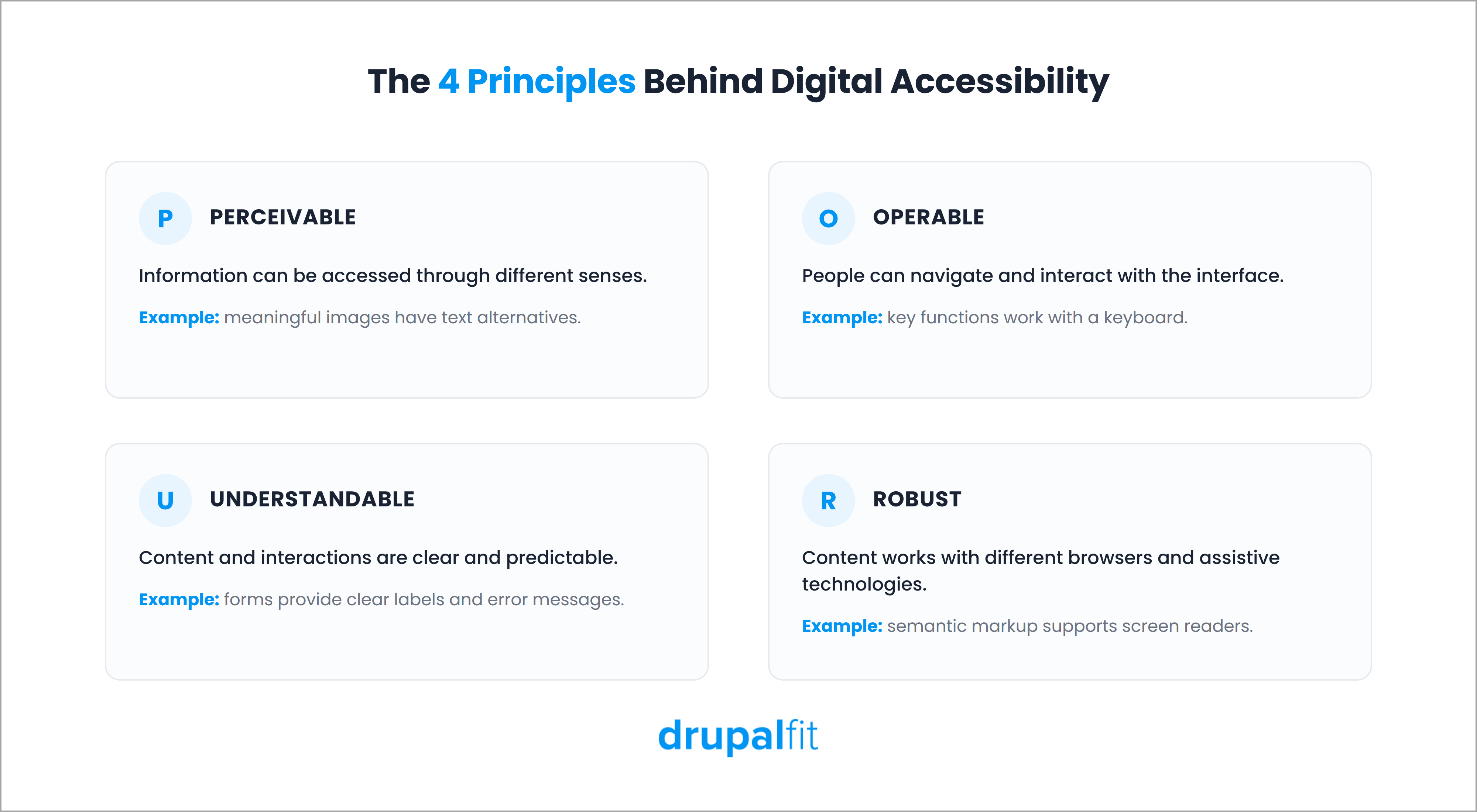
These are the same four principles used by the Web Content Accessibility Guidelines (WCAG), and European Accessibility Act WCAG requirements often get treated as interchangeable, though they aren't quite the same thing. The EAA doesn't directly make WCAG a legal requirement.
Instead, it points to EN 301 549, the European technical accessibility standard. EN 301 549 incorporates WCAG success criteria and connects them to the requirements of the EAA. Common areas to check include:
- Keyboard navigation and visible focus
- Alternative text for meaningful images
- Sufficient colour contrast
- Logical headings and page structure
- Accessible forms and error messages
- Captions and other accessible media alternatives
- Predictable navigation and interactions
- Compatibility with screen readers and other assistive technologies
The EAA also requires covered service providers to provide accessibility information and accessible support mechanisms as part of broader digital accessibility compliance, and the exact obligations depend on the type of service.
What Is EN 301 549 and How Does It Relate to WCAG?
EN 301 549 is the European standard for the accessibility of information and communication technology, maintained by the European Telecommunications Standards Institute. It provides the technical requirements used to assess accessibility under European accessibility legislation.
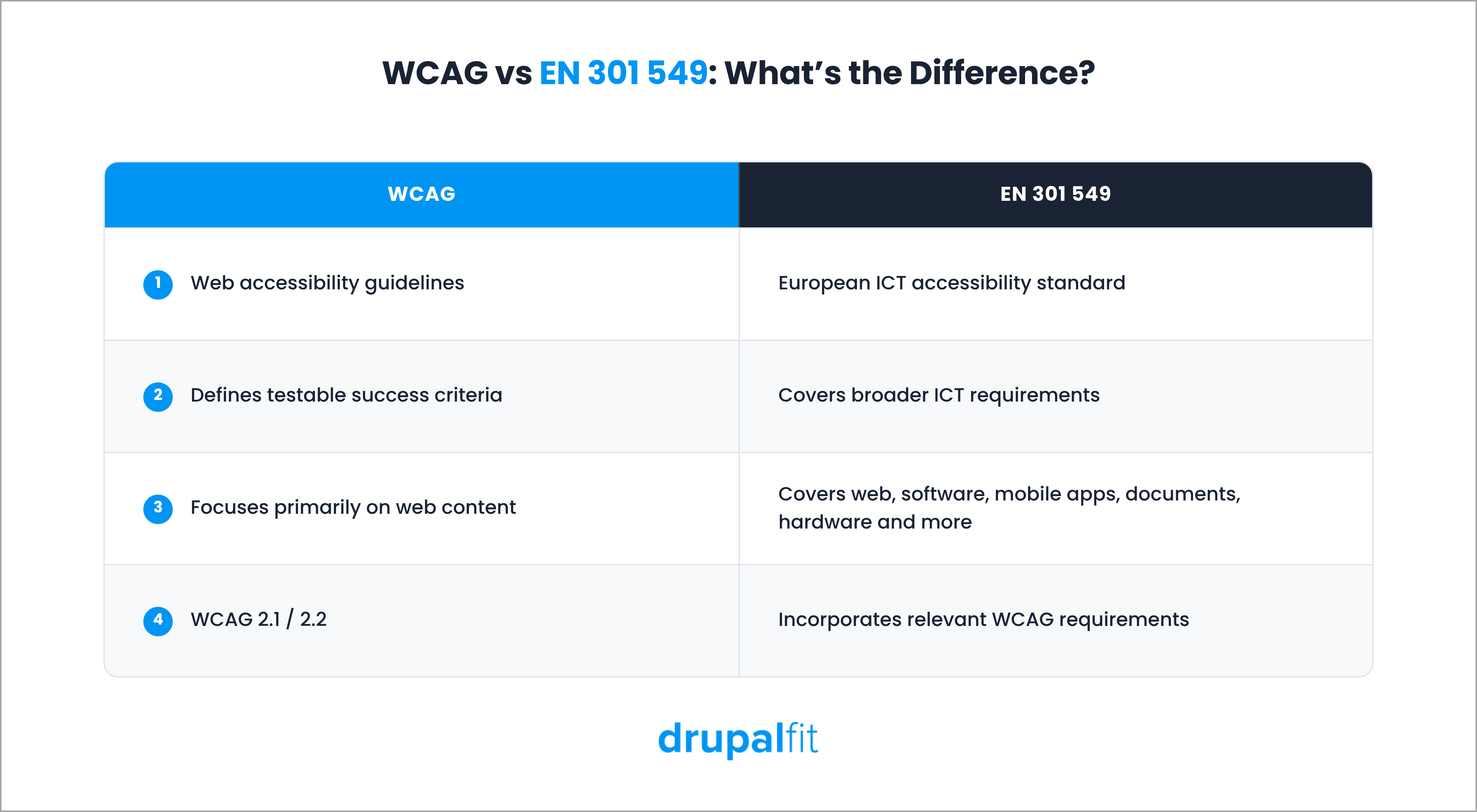
WCAG and EN 301 549 are related, but they are not the same thing. WCAG focuses primarily on making web content accessible and defines specific success criteria that can be tested. EN 301 549 incorporates WCAG requirements but covers a broader range of technology, including software, mobile applications, documents, hardware, and other ICT.
The current harmonised standard is EN 301 549 v3.2.1, which incorporates WCAG 2.1 Level AA for web content. A new version, EN 301 549 v4.1.1, was published on 2 September 2026. It incorporates WCAG 2.2 and introduces further changes to the standard. It is expected to become the new reference standard once it is formally cited in the EU Official Journal.
If you're auditing a Drupal website today for improving website accessibility against ADA and WCAG best practices, WCAG 2.1 AA remains a useful baseline. At the same time, it makes sense to start checking your site against WCAG 2.2 criteria as the standard moves in that direction.
Drupal already gives site teams a few useful building blocks. The Olivero theme was designed with WCAG 2.1 AA in mind, while Drupal's CKEditor includes an accessibility checker for content authors. These features can help, but they don't make a website compliant on their own.
European Accessibility Act Fines and Enforcement
The EAA requires Member States to impose penalties that are effective, proportionate, and dissuasive. But each country sets its own penalties and maximum fines under its national legislation. The potential penalties therefore vary across the EU.
Country | Reported maximum or penalty framework |
Germany | Up to €100,000 for certain violations |
Spain | Up to €600,000 for very serious violations |
Austria | Up to €80,000 |
Ireland | Up to €60,000 |
Italy | Up to €40,000 in certain cases, with additional turnover-based provisions |
Netherlands | Penalties can reach six figures, depending on the applicable national regime |
How to Run a European Accessibility Act Audit on a Drupal Website
An EAA accessibility audit should combine automated checks with manual testing. Here are five main steps that must follow to do a proper audit.
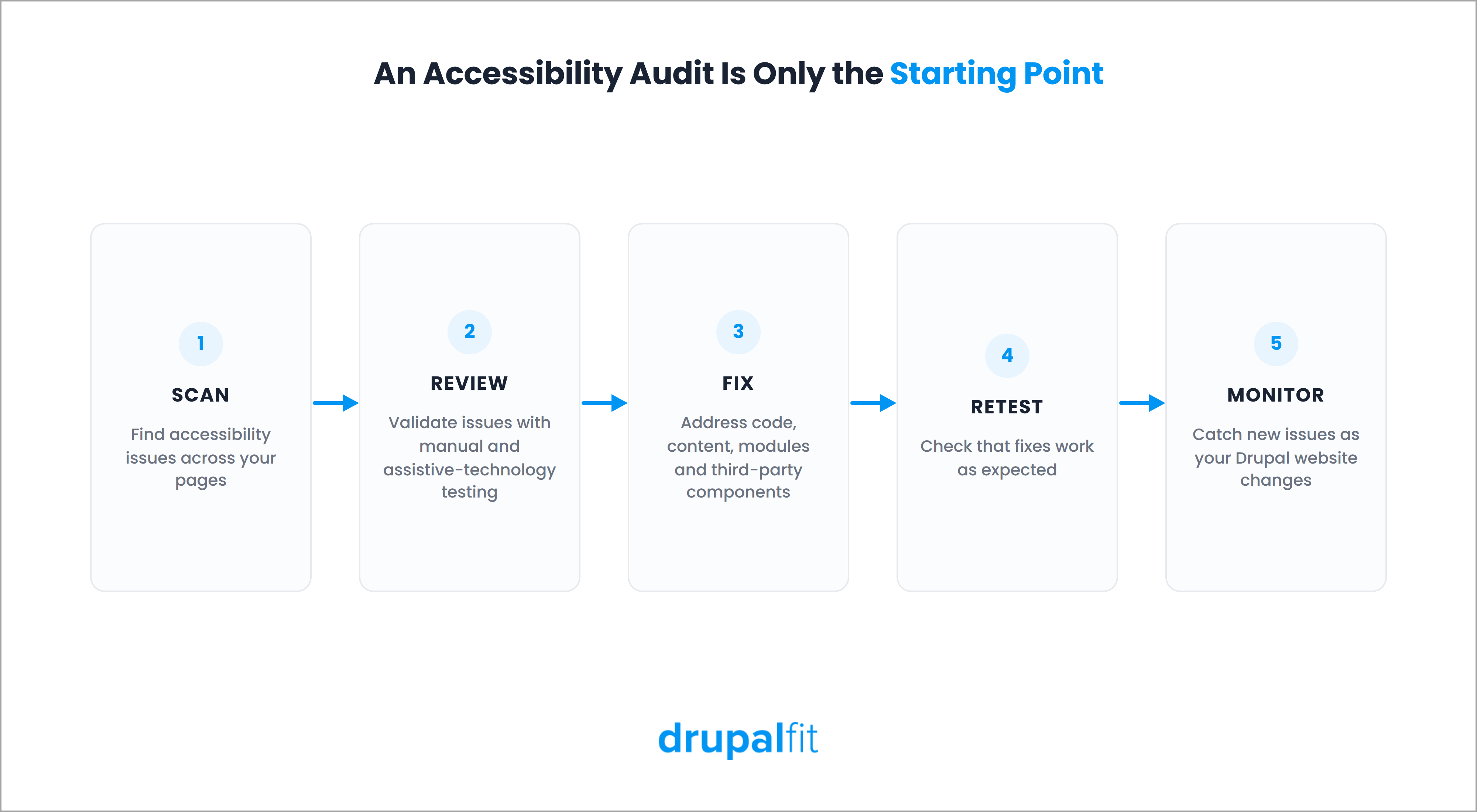
1. Start with automated scanning.
Automated tools can quickly identify issues such as missing alt text, insufficient colour contrast, and heading structure problems. They are useful for finding common issues at scale, but they only catch part of the accessibility picture.
2. Follow up with manual testing.
Test the website using only a keyboard and, where possible, with a screen reader. A tool can tell you that a form has a label, for example, but it can't reliably tell you whether the form actually makes sense to someone using assistive technology.
3. Check your content workflow, not just your theme.
Accessibility problems don't always come from the Drupal theme or code. Content editors can introduce issues by uploading images without alt text or using headings incorrectly. Fixing the theme won't solve those problems.
4. Review third-party modules and embedded content.
Videos, forms, widgets, and other third-party content can introduce accessibility issues of their own. They need to be checked separately rather than assumed to be covered by your Drupal theme.
5. Document issues and keep testing.
Accessibility isn't something you fix once and forget about. New pages, content, modules, and integrations can introduce new barriers, so regular testing should be part of your website maintenance process.
This is where continuous monitoring can be useful. Instead of waiting for an annual accessibility audit, a platform such as DrupalFit can help teams keep track of accessibility issues as their websites change.
Make Your Drupal Website European Accessibility Act Compliant
The European Accessibility Act isn't a one-time checkbox. It's a standard your Drupal website needs to keep meeting as content, modules, and integrations change over time. Getting there starts with an honest audit: know where your site currently stands against EN 301 549 and WCAG, fix what the audit finds, and build a process that catches new issues before they reach your visitors.
That's exactly what DrupalFit is built for. Enter your website URL, and within a few seconds, DrupalFit will audit your pages for accessibility issues across WCAG A, AA, and AAA. You can see the specific issues found, get recommendations for fixing them, and identify common accessibility problems across your site.
You can also integrate DrupalFit with your CI/CD pipeline to automate accessibility checks before each deployment, helping your team catch issues before they make it to production.
Start your free DrupalFit audit today!
FAQs
Does the European Accessibility Act Apply to B2B?
Yes. It applies to B2B and B2C organisations alike, based on whether the end product or service reaches EU consumers.
When Is the European Accessibility Act Deadline?
28 June 2025 for new or updated content. Services unchanged since before that date get until 28 June 2030 under Article 32.
What Are the European Accessibility Act Fines?
Fines vary by country, roughly €60,000 in Ireland up to €600,000 in Spain, with some states adding turnover-based penalties.
Who Does the European Accessibility Act Apply To?
Any organisation offering covered products or services to EU consumers, regardless of location. Microenterprises under 10 employees and €2 million turnover are exempt from service requirements only.