
US Website Privacy Policy Requirements Your Business Must Meet
Palak Agrawal
Published on October 5, 2026
11 min read
Share on:
Your website could be collecting and sharing personal information you do not even realize it has. Under today's US web privacy laws, your business is responsible for that data.
Every form submission, appointment booking, chat, page visit, and click can create data. Analytics platforms, advertising pixels, cookies, and other third-party tools can collect that information in the background and send it to other companies.
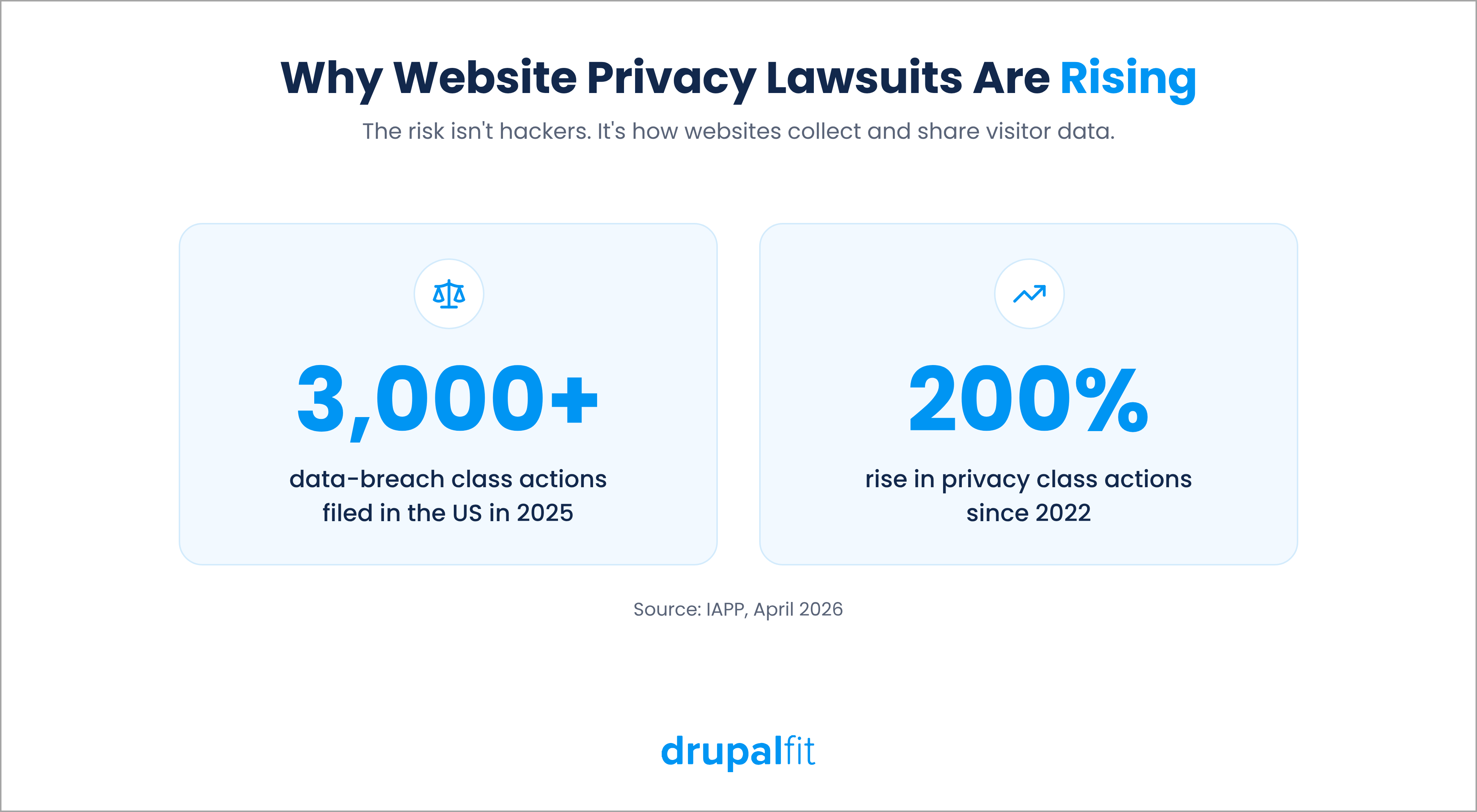
That is becoming a serious privacy and compliance issue for U.S. businesses. In April 2026, the International Association of Privacy Professionals (IAPP) reported that more than 3,000 data-breach class-action lawsuits were filed in the U.S. in 2025. Privacy-related class-action complaints also increased 200% since 2022, with more cases involving tracking pixels and newer ways of collecting and using consumer data.
At the same time, states across the country are introducing and updating privacy requirements. For website owners and compliance teams, this creates a bigger question than just having a privacy policy that meets US website privacy policy requirements, which is, “Is your website actually handling visitor data in a way that complies with the laws that apply to your business?”
Why Website Privacy Lawsuits Are Rising
The growing number of privacy cases makes more sense when you look at what businesses are doing with website data. Take GoodRx, for example.
The company was fined $1.5 million by the FTC after it was accused of sharing users' sensitive health information with advertising companies. This included information about users' medications and health conditions. The company had also told users that it would not share their health information for advertising.
BetterHelp faced a similar case. The FTC alleged that the online therapy company shared sensitive information, including users' email addresses, IP addresses, and health questionnaire responses, with advertising platforms. BetterHelp had promised users that their health information would remain private.
Neither case was about a hacker breaking into a database. The concern was how the companies themselves collected and shared personal information through their digital services.
As more states introduce US web privacy laws and regulators take action against companies that misuse personal data, website privacy has become a much bigger legal responsibility for businesses.
US Web Privacy Laws That Businesses Should Know About
There is no single U.S. privacy law that applies to every business.
Instead, businesses may need to follow federal laws, state privacy laws, and industry-specific requirements. The rules that apply depend on factors like your location, industry, customers, and the type and amount of information you collect. The same is true for website privacy policy requirements USA sites must meet, which vary by state and industry.
1. U.S. Privacy Act of 1974
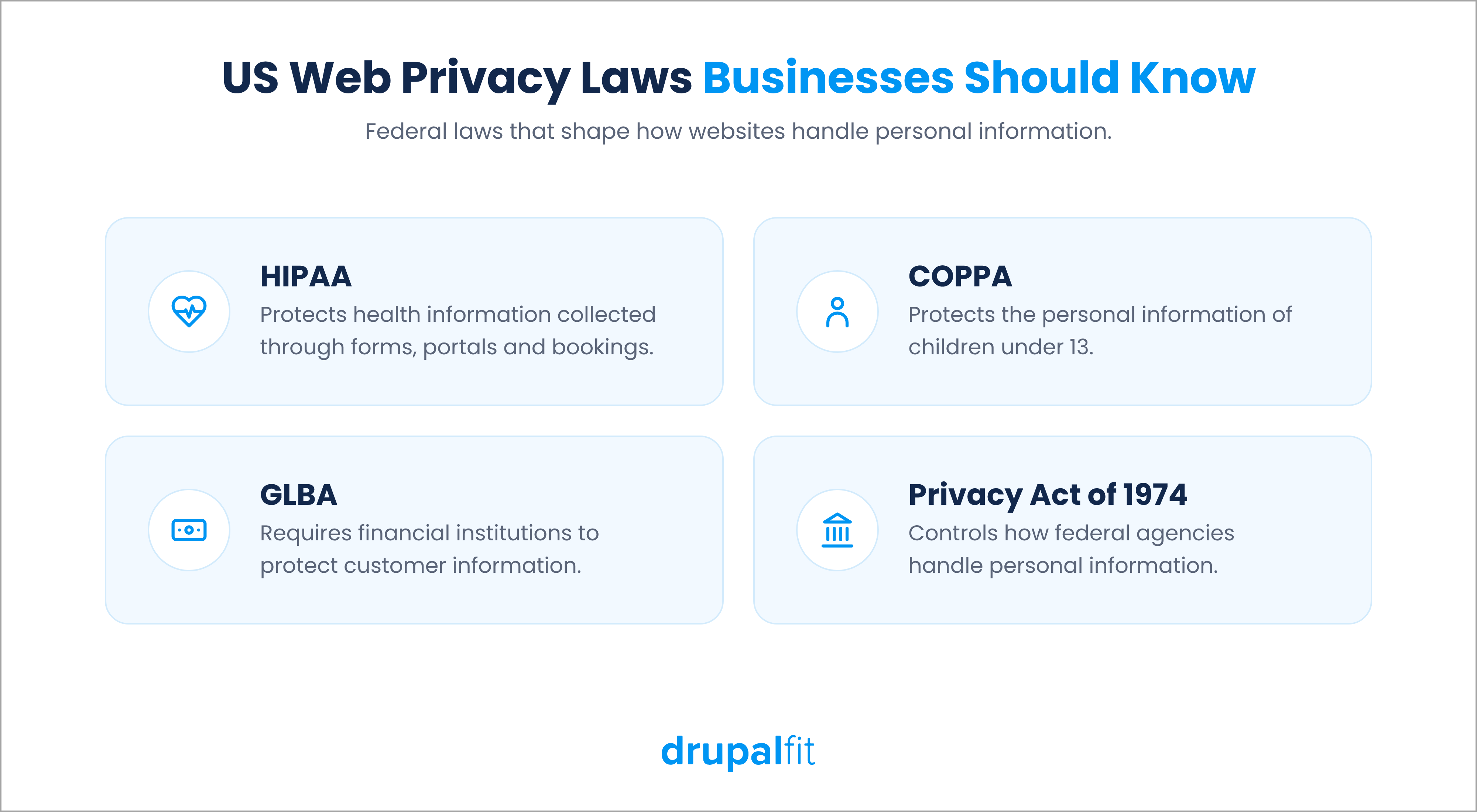
The Privacy Act of 1974 mainly applies to federal agencies and controls how they collect, maintain, use, and disclose personal information.
It is generally not the main privacy law for private businesses. However, organizations that work with federal agencies may need to understand how it affects information handled through those relationships.
2. HIPAA
HIPAA protects certain health information handled by covered healthcare organizations and their business associates.
For websites, this can affect:
- Appointment forms
- Patient portals
- Health assessments
- Patient registration
- Online healthcare services
Healthcare businesses should carefully review website forms and third-party tools that can access health information.
3. COPPA
The Children's Online Privacy Protection Act protects children under 13.
It applies to websites and online services directed at children under 13 and, in certain circumstances, services that know they are collecting information from children under 13.
Covered businesses generally need to provide parents with clear information, obtain the required parental consent, give parents certain control over their child's information, and protect the information they collect.
In February 2026, the FTC also issued a policy statement concerning the use of age-verification technology under COPPA.
4. GLBA
The Gramm-Leach-Bliley Act applies to certain financial institutions.
Covered businesses must explain their information-sharing practices and protect customer information. The FTC's Safeguards Rule also requires covered financial institutions to maintain an information security program.
Banks, lenders, financial advisers, and other covered financial businesses should therefore review how their websites collect and transfer customer information.
New U.S. State Data Privacy Laws
Federal laws are only part of the picture. Several states now have broad consumer privacy laws, while others have narrower privacy and data-security requirements.
1. California
California's CCPA is one of the most important state privacy laws for businesses.
It gives qualifying California residents rights over their personal information, including rights to access, delete, correct, and opt out of certain uses of their data.
In California, US website privacy policy requirements include a privacy policy that explains what personal information you collect, how you use it, and how visitors can use their rights.
California also updated its privacy regulations in 2026. The new rules address areas including privacy risk assessments, cybersecurity audits, and automated decision-making. The regulations became effective January 1, 2026, with some requirements applying later.
2. Colorado
The Colorado Privacy Act gives Colorado residents rights over their personal data and places obligations on covered businesses.
It includes requirements around privacy notices, consumer requests, sensitive data, targeted advertising, and universal opt-out signals.
3. Connecticut
The Connecticut Data Privacy Act gives residents rights over their personal data and places requirements on businesses that meet its applicability thresholds.
As of January 1, 2025, covered businesses must honor universal opt-out preference signals from Connecticut residents.
4. Maryland
The Maryland Online Data Privacy Act took effect in 2025, with enforcement beginning in 2026.
It gives Maryland residents rights over their personal information and places additional restrictions on how businesses collect, use, and sell certain data.
5. Massachusetts
Massachusetts does not currently have a broad consumer privacy law like California's CCPA.
However, businesses still need to follow Massachusetts requirements covering personal information and data security, including the state's data-security regulations.
6. New York
New York also does not currently have a comprehensive consumer privacy law.
Its SHIELD Act does, however, require businesses that maintain certain private information to use reasonable safeguards to protect it.
For website owners, this makes data security an important part of privacy compliance.
7. Virginia
The Virginia Consumer Data Protection Act gives Virginia residents rights over their personal data and places requirements on covered businesses.
These include rules around consumer requests, sensitive data, targeted advertising, data sales, and privacy notices.
Which US Website Privacy Policy Requirements Apply to Me?
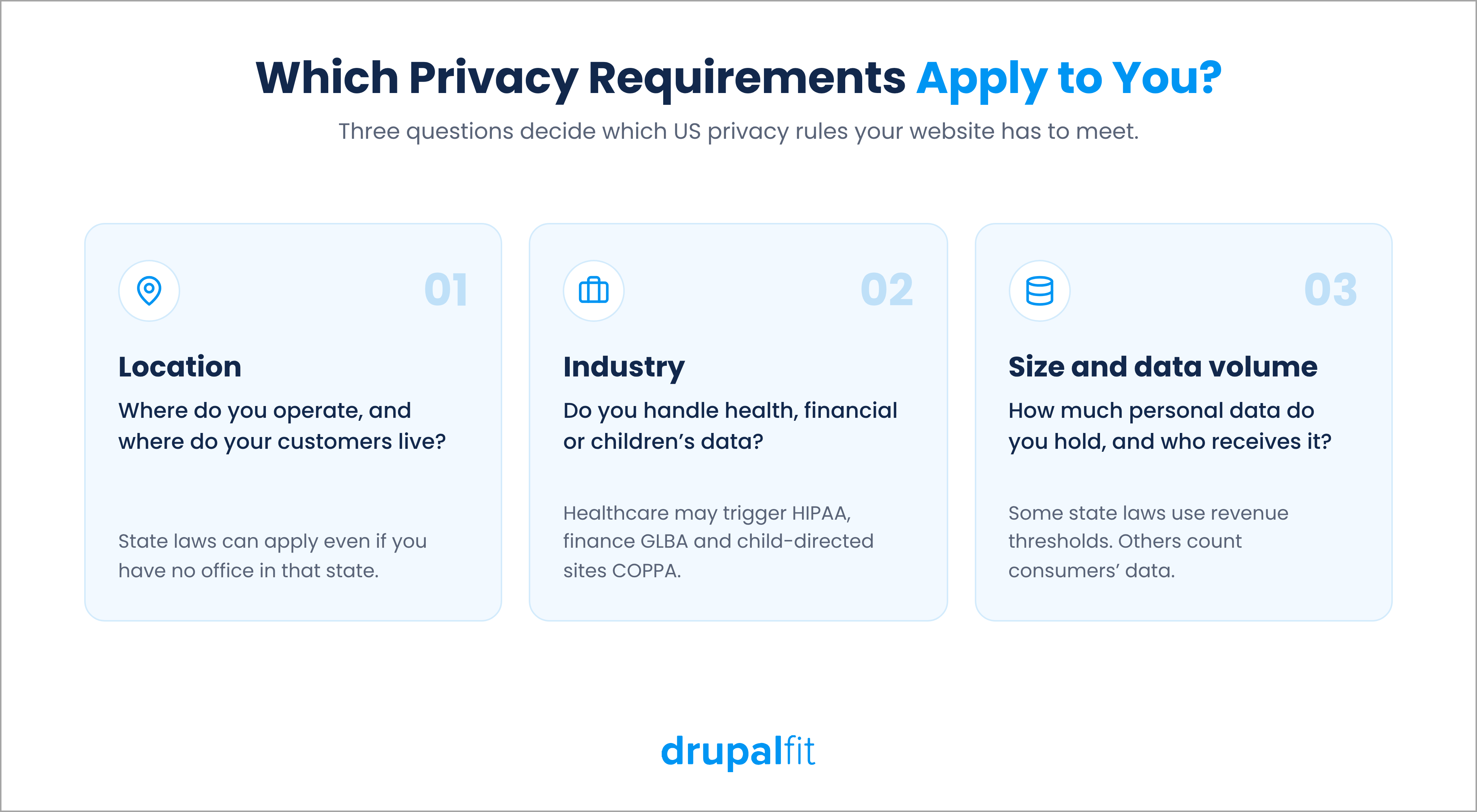
The US website privacy policy requirements that apply to you usually come down to three questions.
1. Location
Identify where your business operates and where your customers are located.
A company does not always need a physical office in a state for that state's privacy law to apply. Some laws can cover businesses that target residents of the state and meet specific requirements.
2. Industry
Your industry can add another layer of requirements.
A healthcare business may need to consider HIPAA. A financial business may need to consider GLBA. A website aimed at children may need to consider COPPA.
3. Size and data volume
Some state laws use revenue thresholds. Others consider how many consumers' data a business processes.
You should know:
- What personal information you collect
- How many consumers' information you hold
- Whether you sell or share personal information
- Which third parties receive it
- How long you keep it
These factors can help you identify which privacy requirements apply to your organization, including website policy requirements USA that differ by state.
What Websites Need Under Website Privacy Policy Requirements USA
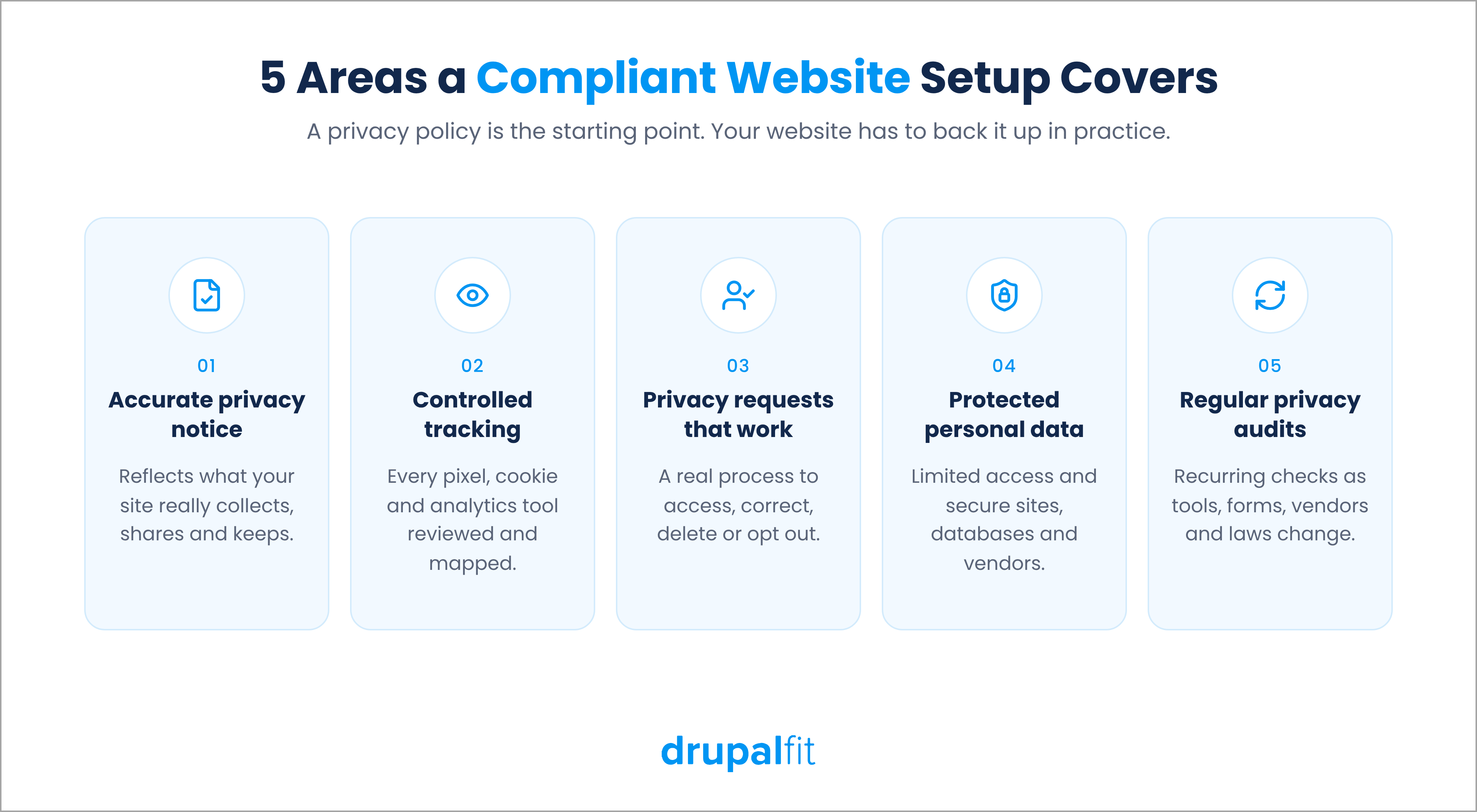
A website that meets website privacy policy requirements USA should cover at least these five areas:
1. Accurate privacy notice
Explain what information you collect, why you collect it, who receives it, how long you keep it, and what rights visitors have.
The notice should reflect what the website actually does. A notice that meets US website privacy policy requirements has to match your real data practices, not a template.
2. Controlled tracking
Review every analytics tool, advertising pixel, cookie, chat tool, and other tracking technology on the website.
Know what each tool collects and where that information goes.
3. Working privacy requests
If visitors have the right to access, correct, delete, or opt out of certain uses of their information, your business needs a process to handle those requests.
4. Protection of personal information
Limit access to personal information and review the security of your website, databases, cloud services, and third-party providers.
5. Regular privacy audits
Websites change constantly. New marketing tools are added. Forms change. Vendors change. Laws are updated.
Review your website regularly to check whether your actual data practices still match your privacy requirements.
Common Website Compliance Mistakes in the USA
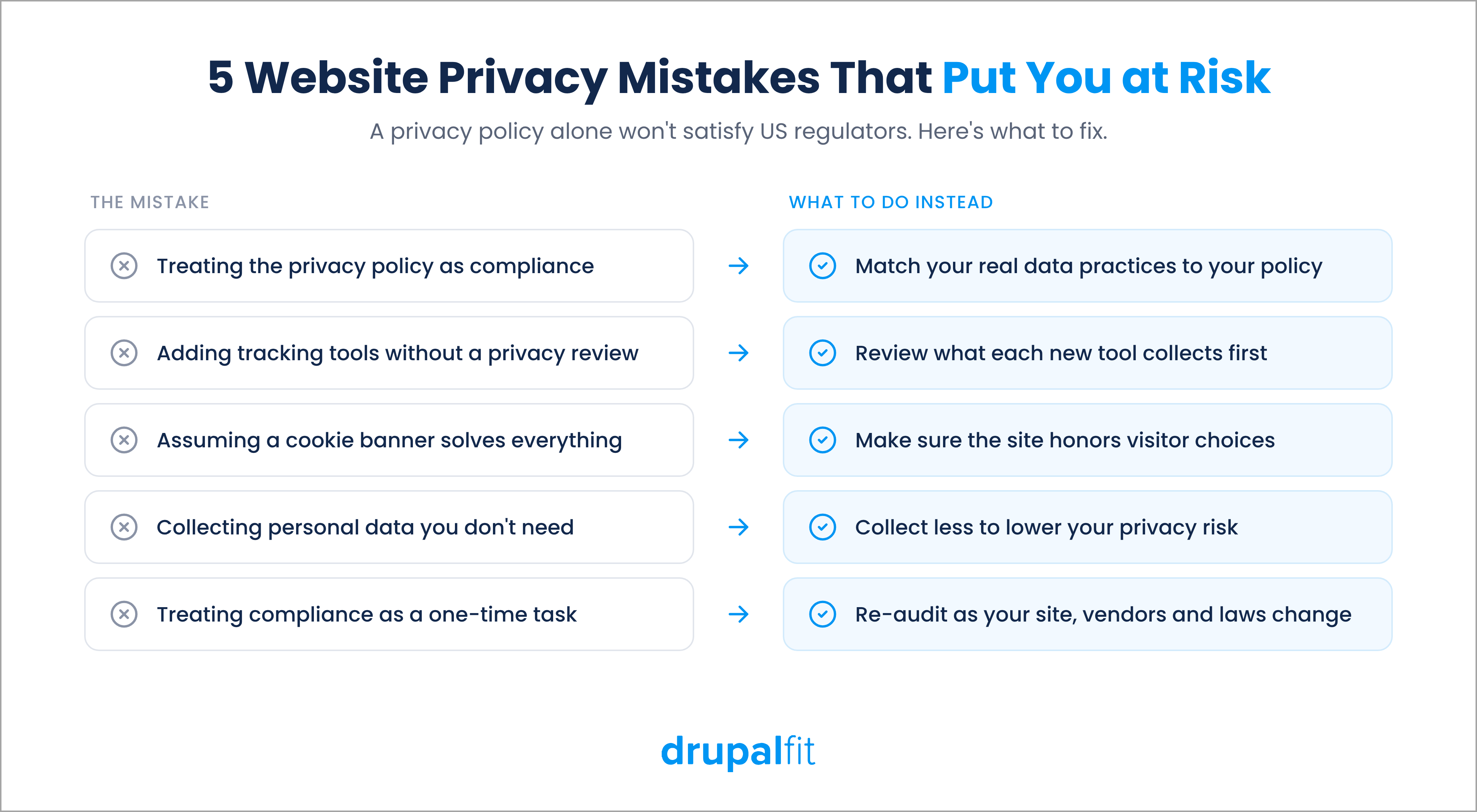
A privacy policy alone does not meet website policy requirements USA regulators enforce. Avoid these five mistakes.
1. Treating the privacy policy as compliance
Meeting website privacy policy requirements USA is only the starting point. A privacy policy cannot fix a website that collects or shares information in ways that conflict with the policy.
2. Adding tracking tools without a privacy review
Every new analytics, advertising, or marketing tool can change what information your website collects.
3. Assuming a cookie banner solves everything
A banner does not automatically make a website compliant. The website must actually follow the visitor's choices.
4. Collecting unnecessary information
If you do not need certain personal information, consider whether you should collect it at all. Collecting less data reduces privacy risk.
5. Treating compliance as a one-time task
A website audit from last year cannot tell you exactly what your website is doing today. Privacy compliance needs regular reviews as your website, vendors, and legal requirements change.
Make Your Website GDPR Compliant
Website privacy compliance requires more than having a privacy policy or meeting website policy requirements USA. Businesses should regularly review how their websites collect, use, and share personal information.
- Know which US web privacy laws apply based on your location, industry, and business activities.
- Be transparent about data collection and clearly explain how visitor information is used.
- Review third-party tools such as analytics, advertising pixels, chat tools, and other tracking technologies.
- Give users the required privacy controls and make sure they actually work.
- Audit your website regularly as privacy requirements and website technologies change.
DrupalFit’s GDPR Privacy Policy Audit can help identify privacy gaps across your website and give your team clear findings to work on. Regular audits can help businesses catch privacy issues before they turn into bigger compliance problems.
FAQs
Is it a legal requirement to have a privacy policy on a website?
Yes. If your website collects personal information, you may be legally required to have a privacy policy explaining how that data is collected and used.
Is GDPR required in the USA?
No. GDPR does not apply to every U.S. business. It can apply if your business collects or processes personal data from people in the EU.
What are the main privacy regulations in the United States?
There is no single U.S. privacy law. Businesses may need to follow federal and state privacy laws based on their industry, location, and activities.
Is it illegal to have a website without a privacy policy?
Yes, in some cases. If your website collects personal information or uses tracking tools such as cookies and analytics, privacy laws may require you to provide a privacy policy.
What happens if I don't comply with GDPR?
You can face serious penalties. GDPR violations can result in fines of up to €20 million or 4% of annual global turnover, whichever is higher, along with legal and reputational consequences.