
SEBI Digital Accessibility Compliance: What Regulated Entities Must Do Before July 31
Palak Agrawal
Published on May 14, 2026
8 min read
Share on:
If you run a SEBI-regulated digital platform, the July 31, 2026 remediation deadline is now close. By then, every accessibility issue identified in your audit must be fixed and validated as part of SEBI accessibility compliance.
This requirement comes at a time when digital access is central to financial participation. More than 1.3 billion people worldwide live with some form of disability, including 63.28 million people in India. For many of them, accessibility determines whether they can open a trading account, review a mutual fund statement, track a portfolio, or file a complaint without barriers.
Yet accessibility gaps remain widespread. A November 2024 report by BarrierBreak and NCPEDP found that 91.55% of financial websites failed basic accessibility standards. Common issues included:
- 97% had missing or incorrect headings
- 96% had image description errors on homepages
- 77% had keyboard navigation issues
- 26% had low text contrast
SEBI’s 2025 circulars address this gap by making digital accessibility mandatory for regulated entities in India. This has made SEBI digital accessibility compliance a priority for every regulated entity.
This article explains what the SEBI digital accessibility circular requires, who it applies to, and what your team needs to do before the deadline.
Why Did SEBI Introduce Digital Accessibility Regulations?
On April 30, 2025, the Supreme Court delivered a landmark judgment in Pragya Prasun & Ors. vs. Union of India & Ors. and Amar Jain vs. Union of India & Ors.
In this judgment, the Court declared that access to digital services, including electronic Know Your Customer, or e-KYC processes, is an intrinsic part of the right to life and dignity under Article 21.
Following this, the Court directed the Central Government, its ministries, the Reserve Bank of India, SEBI, and the Telecom Regulatory Authority of India to frame and enforce appropriate accessibility standards.
It was after this judgment that SEBI issued a circular mandating regulated entities to comply with the prescribed digital accessibility requirements and relevant provisions of the Rights of Persons with Disabilities Act, 2016 and its corresponding rules.
What Did the SEBI Digital Accessibility Circular Mandate Include?
SEBI’s digital accessibility mandate began with its first SEBI digital accessibility circular issued on July 31, 2025. The circular set the compliance requirements, reporting process, and key timelines for regulated entities.
As part of this process, financial companies were required to complete two key actions by April 2026:
- Submit the list of their digital platforms and compliance report
- Submit the readiness and compliance status report
The next phase is about fixing the issues found during accessibility audits and preparing for ongoing reporting.
July 31, 2026
By July 31, 2026, regulated entities must fix the accessibility issues identified in their audits. This includes:
- Fixing WCAG-related issues across websites, portals, apps, and digital documents
- Resolving barriers such as missing form labels, poor heading structure, keyboard navigation issues, low contrast, and inaccessible PDFs
- Retesting fixes to confirm they work
- Keeping evidence of remediation and validation
April 30, 2027
From April 30, 2027, annual accessibility reporting begins. This means accessibility cannot be treated as a one-time audit. Regulated entities will need a repeatable process to audit platforms, fix new issues, track progress, and maintain records every year as part of SEBI digital accessibility compliance.
Who Has to Follow SEBI Accessibility Guidelines?
The question is, who does this mandate apply to? Well it applies to every SEBI-regulated entity that operates investor-facing digital platforms.
- Stock exchanges and their trading platforms
- Clearing corporations
- Depositories and depository participants
- Stock brokers and their investor portals
- Mutual funds and asset management companies
- Portfolio managers
- Investment advisers
- Research analysts
- KYC Registration Agencies
- Market Infrastructure Institutions
- Credit rating agencies
- Any other SEBI-registered intermediary operating a website, mobile app, portal, or digital investor communication channel
What SEBI Accessibility Guidelines Do Websites Need to Follow?
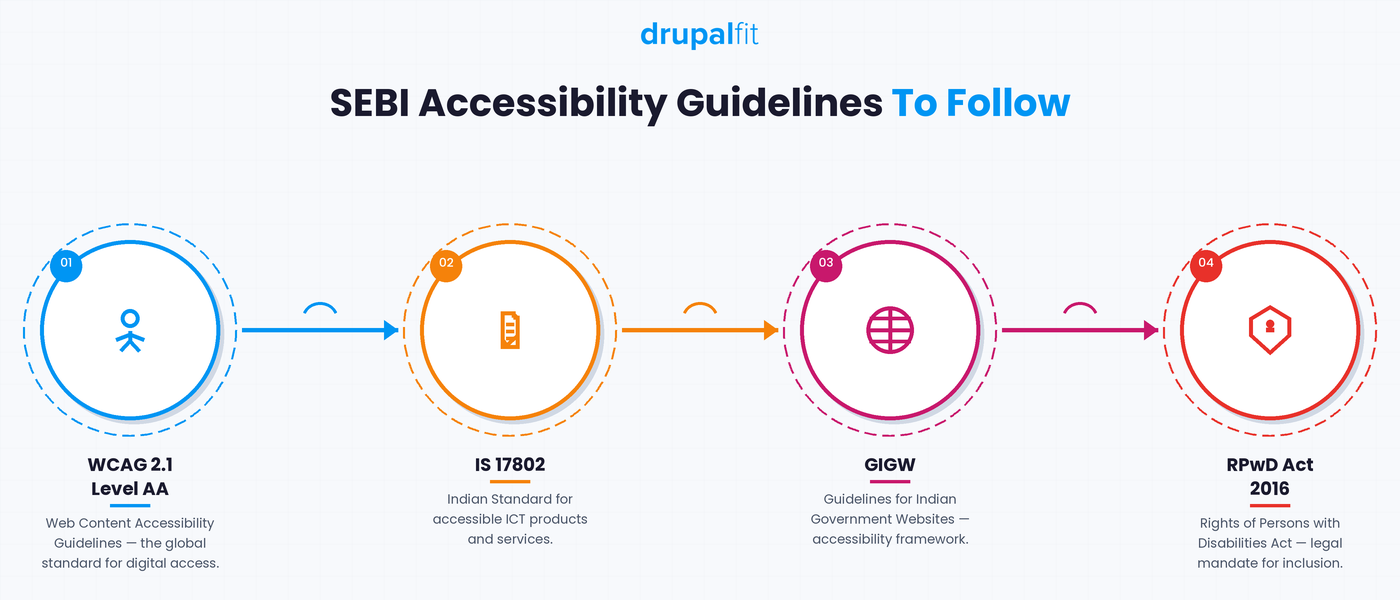
SEBI's circulars reference three primary standards. Here is what each one requires.
1. WCAG 2.1 Level AA
WCAG, or Web Content Accessibility Guidelines, is published by the W3C and is the global benchmark for digital accessibility. It organizes requirements under four principles:
Perceivable means users must be able to perceive the information on the page. This includes text alternatives for images, captions for videos, readable colour contrast, proper labels, and content that works with screen readers.
Operable means users must be able to navigate and use the website. This includes keyboard access, visible focus states, enough time to complete actions, no keyboard traps, and clear navigation.
Understandable means users must be able to understand the interface and content. This includes readable language, consistent navigation, meaningful error messages, and predictable form behaviour.
Robust means the website must work reliably with assistive technologies. This includes semantic HTML, correct ARIA usage, proper form markup, and compatibility with screen readers and other tools.
2. IS 17802:2021
India's national standard for ICT accessibility. It aligns closely with WCAG 2.1 but is specifically calibrated for Indian digital platforms, including trading portals, investor dashboards, and financial document systems. It covers websites, mobile apps, and digital documents, and is the standard SEBI references for technical audit benchmarking under SEBI digital accessibility regulation.
3. GIGW 3.0
These guidelines govern public-facing digital platforms in India, including those operated by public sector financial institutions. They cover navigation consistency, semantic markup, metadata standards, and accessible page structure.
For investor portals and statutory reporting platforms, GIGW compliance ensures that screen readers and search functions can accurately interpret financial content like NAV tables and shareholding data.
4. Rights of Persons with Disabilities Act, 2016
The Rights of Persons with Disabilities Act, 2016 forms the legal basis of SEBI’s accessibility mandate. It requires equal access to public services, including digital services.
Some of the key provisions that regulated entities need to follow include:
- Section 40- Accessibility
- Section 42- Access to information and communication technology
- Section 46- Time limit for accessibility by service providers
- Rule 15(1)(c) of the Rights of Persons with Disabilities Rules, 2017- Rules for accessibility
Why Is It Important to Follow These Guidelines?
If a platform is not accessible and does not comply with the above-mentioned SEBI accessibility guidelines, the impact is not limited to lost users or poor digital experience. It can also lead to fines, penalties, and regulatory action.
The table below shows the penalties that may apply for accessibility non-compliance.
| Section | Penalty/Fine | Authority/Law |
| First Offense under RPwD Act Section 89 | INR 10,000 | Rights of Persons with Disabilities Act, 2016 |
| Subsequent Offenses under RPwD Act Section 89 | INR 50,000 to INR 5,00,000 | Rights of Persons with Disabilities Act, 2016 |
| SEBI-Regulated Entities | Same as above, along with possible regulatory action | SEBI Circular dated July 31, 2025 |
| SEBI Circular dated July 31, 2025 | INR 10,000 to INR 5,00,000 under the RPwD Act | RBI Digital Banking Guidelines |
This is already being enforced. In February 2025, the Court of the Chief Commissioner for Persons with Disabilities fined nearly 155 establishments INR 10,000 each for failing to meet digital accessibility standards. These included central ministries, departments, and private establishments.
And that’s not it. In July 2025, this penalty increased even more. The same court fined 96 establishments INR 50,000 each for continued non-compliance with accessibility standards for websites, mobile apps, and other digital platforms.
How Can Websites Ensure SEBI Accessibility Compliance?
Now that you know the repercussions of not complying with the mandate, it is important to understand how you can make sure your website follows the required accessibility guidelines. Here’s what you need to keep in mind:
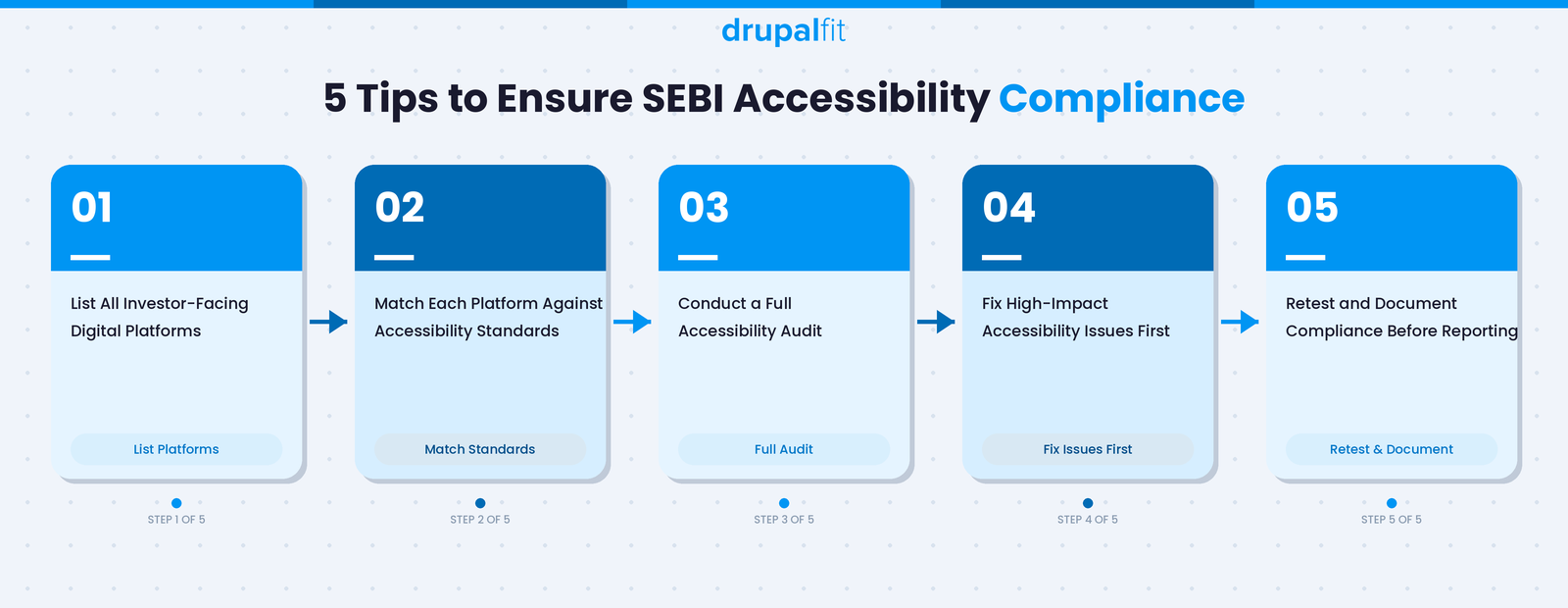
1. Identify Every Investor-Facing Platform
List every website, app, portal, dashboard, KYC flow, trading interface, grievance form, and document investors use. If investors rely on it, include it in the review.
2. Map Platforms to Accessibility Standards
Map each platform against WCAG 2.1 Level AA, GIGW, IS 17802, and the RPwD Act, 2016. This gives teams a clear testing and remediation baseline for SEBI accessibility compliance.
3. Run an Accessibility Audit
Run automated and manual tests across keyboard navigation, screen readers, forms, documents, mobile experience, and assistive technologies.
4. Prioritise Critical Issues
Fix issues that block key actions first. This includes inaccessible login flows, missing labels, keyboard traps, broken focus order, low contrast, inaccessible PDFs, and form errors.
5. Validate Before Reporting Compliance
Run the audit again after fixes. Verify the issues, retest key journeys, and document the results before reporting compliance under the SEBI digital accessibility circular.
How Can DrupalFit Help SEBI-Regulated Websites Prepare Before July 31?
For organisations running investor-facing websites, accessibility compliance can be difficult to manage manually. Issues may exist across templates, forms, components, content blocks, PDFs, landing pages, media embeds, and third-party integrations.
DrupalFit helps teams audit websites for accessibility and identify WCAG A, AA, and AAA-related issues. It categorises issues by severity and provides clear remediation guidance, so teams know what needs attention first.
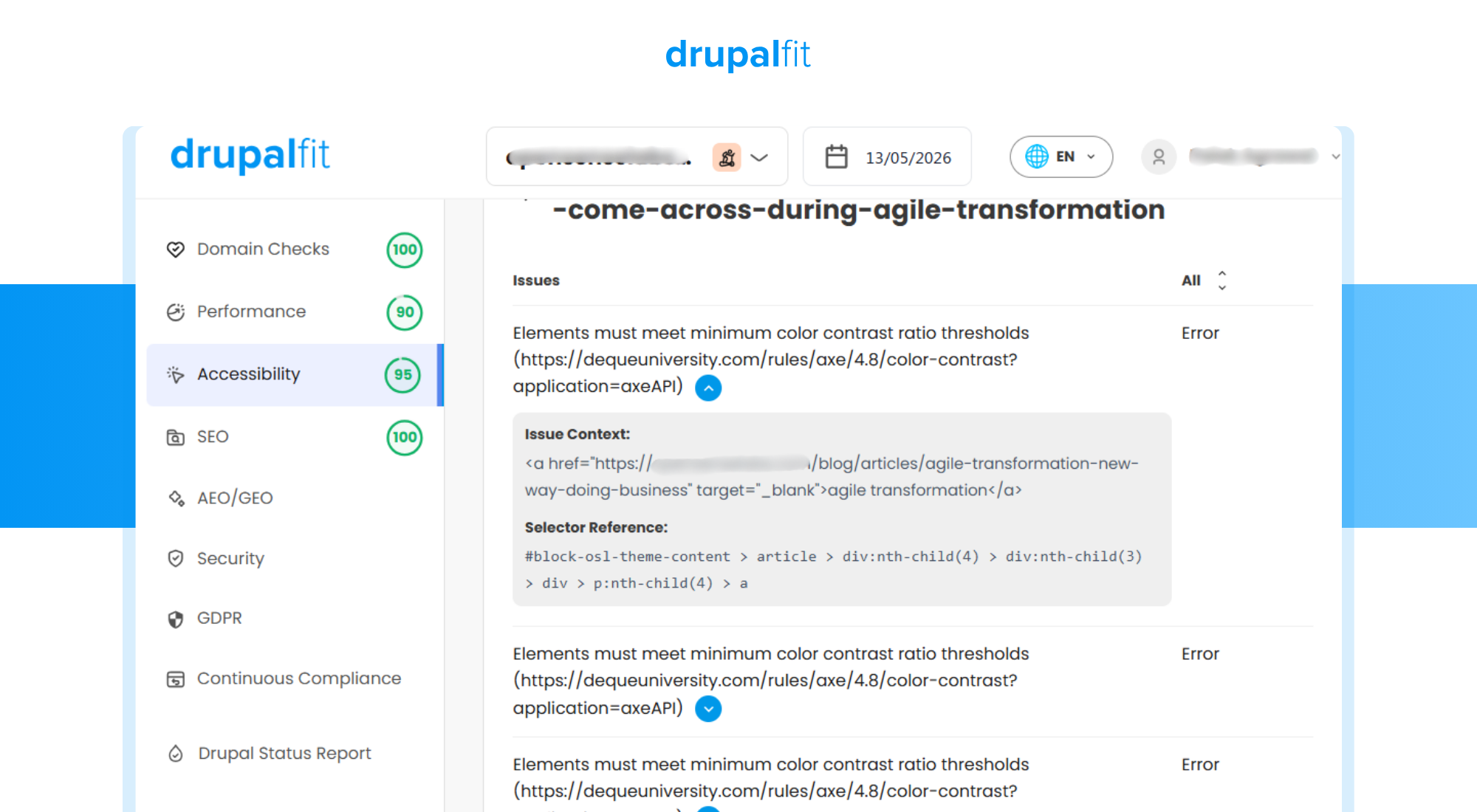
Running an audit is simple-
- Visit drupalfit.com
- Enter your website URL
- Run the audit
Once the audit is complete, open the Accessibility section from the left-side panel. The report gives a clear view of your website’s accessibility status, including-
- Which pages have accessibility issues
- What type of WCAG issue exists
- What specific issue appears on each URL
- What developers need to fix
- How each issue can be fixed
By using DrupalFit, your team gets a clear view of your website’s accessibility posture before the upcoming deadline. It helps identify what needs to be fixed, where the issue appears, and how developers can address it, so your team can move from audit findings to remediation with more clarity.