
Is an llms.txt File Necessary for AI SEO ? What Experts Say
Palak Agrawal
Published on July 12, 2026
8 min read
Share on:
Llms.txt file is not for SEO purpose.
The actual purpose of an llms.txt file, as explained in a document released by Chrome for Developers, is to give AI agents a quick, machine-readable summary of a website. Without it, agents may spend more time crawling a site just to figure out its structure and main content.
That is the intended use case. But over the last few weeks, a different argument has been brewing online, and it has nothing to do with AI agents completing tasks. SEOs and marketers are now asking if an llms.txt file is necessary for SEO.
Does adding one help your website rank in Google Search?
Does it help you rank in AI Overview?
Does it get you cited more often by ChatGPT and Claude?
This article looks at where llms.txt comes from, how it works, and whether adding one to your website actually changes anything for your search visibility or your AI search visibility.
What Is an llms.txt File?
An llms.txt file is a plain text file, written in Markdown, that sits at the root of your website (yourdomain.com/llms.txt). It points AI models to the pages you consider your best content, things like documentation, FAQs, product pages, and in-depth guides.
The idea comes from a standard proposed on llmstxt.org. Instead of making an AI model crawl your entire site to find your useful content, you give it a shortlist upfront.
How is an llms.txt File Different from a Robots.txt File?
Robots.txt controls what search engine crawlers can and cannot access on your website.
llms.txt does not control access. It does not block or allow anything. It simply lists the pages you want an AI model to read, so the model does not have to search your entire site to find them.
Sitemap.xml lists every page on your website, mainly for search engine discovery. llms.txt is more selective. It only includes your strongest, most useful pages, written in a format AI models can read quickly.
So the three files serve different purposes: robots.txt controls access, sitemap.xml helps with discovery, and llms.txt curates your best content for AI models.
How Is an llms.txt File Formatted?
Most technical SEO files, like sitemap.xml, use XML. An llms.txt file is different. It is written in Markdown, the same simple formatting language used for headings and lists in a basic text document. The reason comes down to who is reading it. Markdown is easier for AI models and agents to parse than a rigid structured format, which is why the standard was built around it.
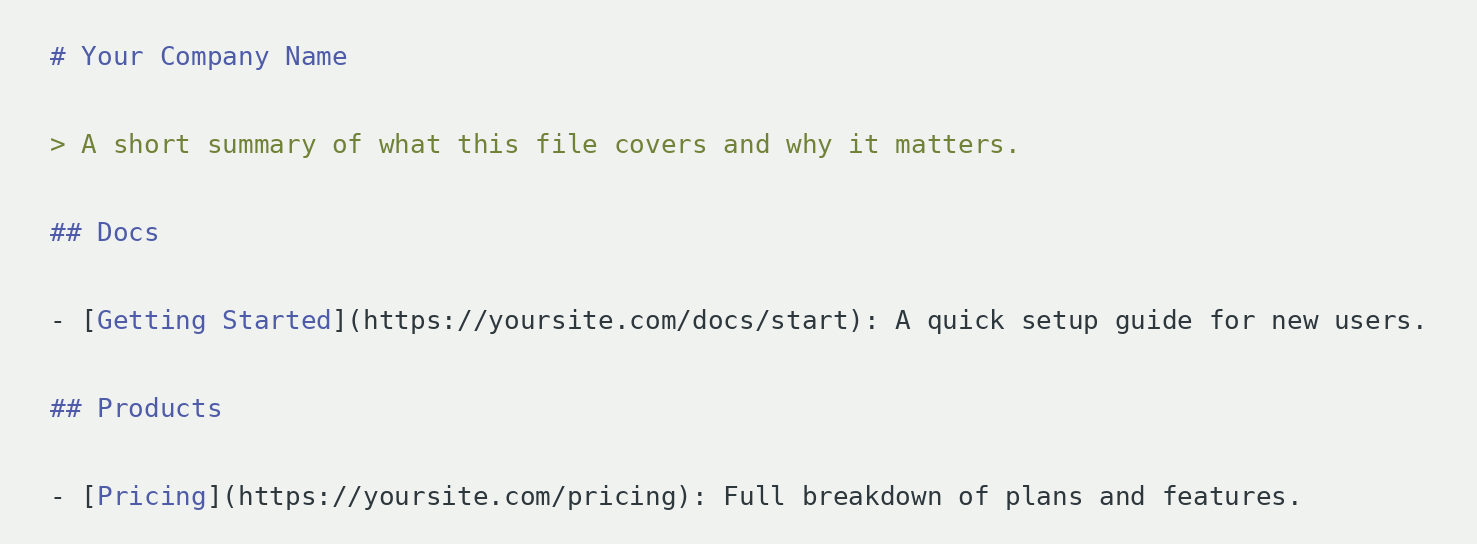
Even so, an llms.txt file is not a free-for-all. It follows a defined structure, and that structure matters because it lets both AI models and standard programmatic tools read the file correctly. A properly formatted llms.txt file includes:
- One H1 heading with your site or project name. This is the only required element in the entire file.
- A short blockquote right below the heading, summarizing what the file is about and what kind of content it points to.
- Optional paragraphs for extra context, if you want to explain your site or business in more detail before listing links.
- One or more H2 sections that group your links by category, such as "Docs," "Products," or "Guides." Each link includes the page title, its URL, and a one-line description of what the page covers.
Here is an llms.txt file format example you can adapt for your own site:
Is an llms.txt File Really Needed for SEO?
Now to the most important part: is an llms.txt file necessary for SEO? There is no single answer. Search the web and you will find articles telling you to add it right away, and just as many telling you it is a waste of time, or asking outright if llms.txt is worth it in 2026 at all.
Here is what we know for certain, provider by provider, which also answers whether AI models like ChatGPT and Claude actually read llms.txt files today:
- OpenAI (GPTBot): Honors robots.txt for crawl access but has not officially confirmed it reads or ranks content based on llms.txt.
- Anthropic (Claude): Publishes its own llms.txt file at anthropic.com, but has not stated that its crawlers use the standard to decide what to cite.
- Google (Search, Gemini): Uses robots.txt, through the Google-Extended user agent, to manage AI crawl behavior. There is no mention of llms.txt anywhere in its crawler documentation, which directly answers whether Google uses llms.txt for search rankings: it does not.
- Meta (LLaMA): No public crawler guidance and no indication it reads llms.txt at all.
None of the four confirm using llms.txt to decide what gets cited or ranked. That is the actual state of adoption today, not speculation.
The debate picked up pace when Google released a guide on optimizing for generative AI search.
In it, Google directly addressed llms.txt in a section built to clear up common myths. The guide states plainly that Google Search does not rely on llms.txt or any special markdown file, and having one will not affect how your site ranks in Google Search or shows up in AI Overviews.
But Google added a note right after that.
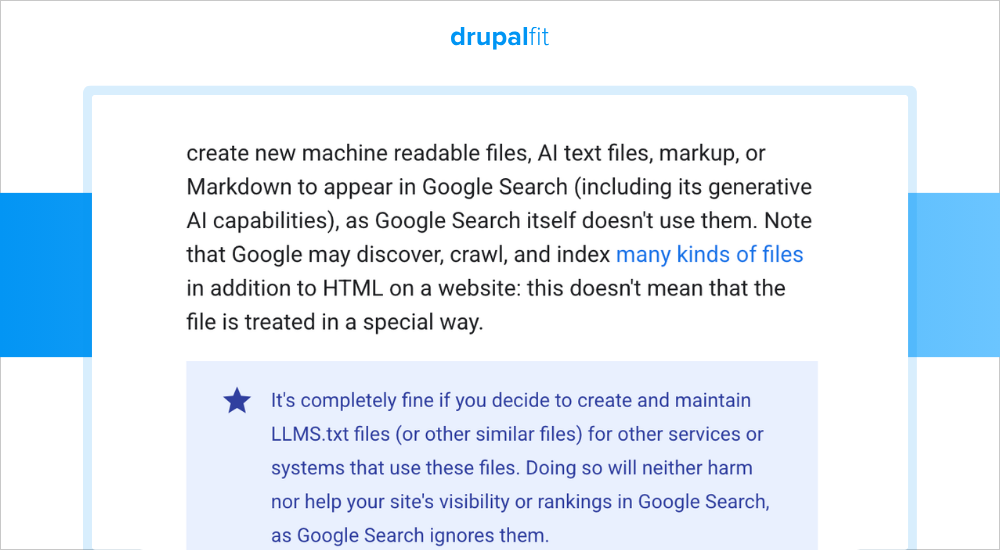
llms.txt can still be useful for other systems and services that choose to read it, even if Google Search itself does not use it for ranking.
Then on May 20, Google added an "Agentic Browsing" check to Lighthouse, its page speed and site auditing tool. This check looks at whether your website has an llms.txt file and whether it is structured correctly.
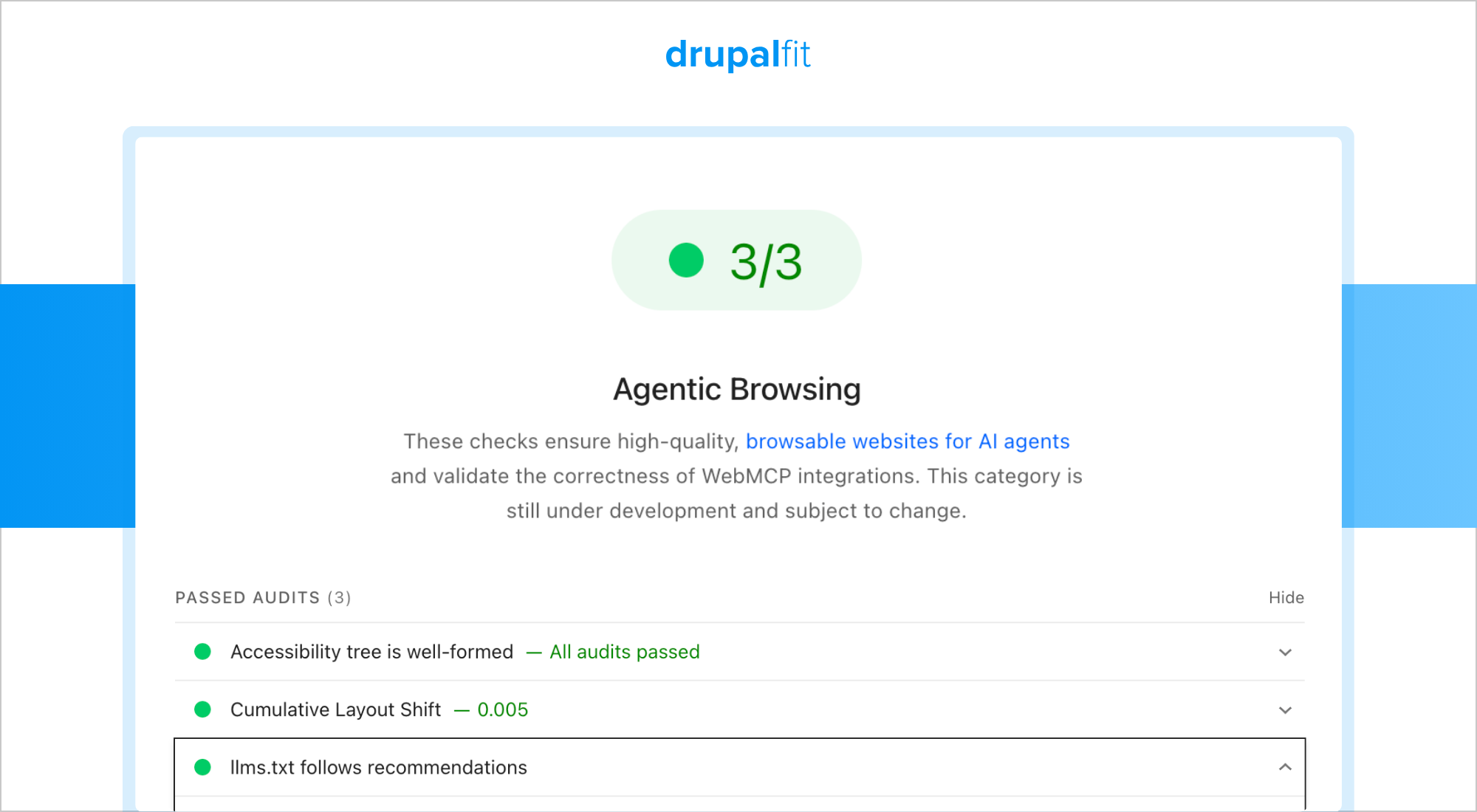
This looks contradictory at first glance. Google says the file will not help you rank, yet checks for it in one of its own tools. But the contradiction disappears once you separate the two use cases.
Ranking in Google Search is one problem. Helping an AI agent understand your website while it completes a task, like booking a flight or comparing product specs, is a different problem entirely. llms.txt was built for the second case, not the first.
Our take is if AI models do use this file to understand your website structure and content, it is worth having. If an AI model understands your services and what you offer more clearly, it becomes easier for that model to mention your brand when someone asks a question related to what you do.
This will not directly boost your rankings in Google Search or inside an LLM, but it can improve your chances of showing up in the answer itself.
What Are Experts Saying About the llms.txt Debate?
Here is what experts have to say about whether you actually need an llms.txt file for SEO.
John Mueller, Search Advocate at Google — says llms.txt is not built for search and compares it to the old keywords meta tag: a claim the site owner makes about their own content, with no real verification behind it.
Jeremy Howard, Co-founder of Answer.AI and creator of the llms.txt proposal — built the standard to solve a real problem: LLMs have small context windows and struggle with messy HTML. He believes content built for AI consumption is the direction the web is heading.
Kevin Dam, CEO and Founder of Aemorph — takes the middle path. He agrees there is not enough evidence that llms.txt improves AI citations or rankings today, but does not dismiss it either. In his view, it is a useful addition, not an essential one, and it should never take priority over quality content, a sound website, and topical authority, which still do the heavy lifting in both traditional and AI search.
The Bottom Line
llms.txt was not built to boost your rankings in Google Search. It will not help your website rank higher in AI Overviews, and it will not directly get your site "ranked" inside ChatGPT, Claude, or any other language model, because that is simply not what the file is designed for.
What llms.txt actually does is help AI models understand how your site is structured and gives them a shortcut to your raw, easy-to-read content, which can improve how efficiently an LLM consumes what you have published.
The bigger point buried under all this back-and-forth is that llms.txt cannot fix a website that is slow, poorly structured, or thin on content. It only points to content that should already be strong on its own. If you have not audited the fundamentals of your website's SEO and AI visibility lately, that is where the actual gains are sitting, in Google Search and in AI-generated answers alike.
Not sure where your website actually stands? Run a free SEO and AI visibility audit with DrupalFit and find out in minutes.