
GEO and AEO: Key Differences & What Matters in 2026
Nisha Katariya
Published on April 13, 2026
11 min read
Share on:
"Search has evolved beyond rankings to include direct answers and AI citations. GEO and AEO in SEO now define how content gets discovered, selected, and cited. Visibility now depends on optimizing for all three layers together."
What once revolved around ranking on Google has now shifted toward being selected, summarized, and cited by AI systems.
A recent study revealed that 90% of businesses are concerned about the future of Search Engine Optimization (SEO) due to AI and large language models (LLMs). - Smartly Marketing
At the same time, AI Overviews are becoming a default part of search, and tools like ChatGPT, Perplexity, and Gemini are changing where people go first when they have a question. And AI referrals to top websites have already surged 357% year-over-year, from June 2024 to June 2025.
As a result, digital marketing strategies are being redefined in real time.
GEO and AEO in SEO each serve a different purpose in this new landscape. Yet most brands either focus on one or treat them as the same. Understanding how they differ, and how they work together, is now essential to staying visible.
What are GEO and AEO in SEO?
Five years ago, SEO had a clear and simple job: get your page to the top of Google's results. Users will see ten blue links, pick one, and visit your site.
Today, search results focus on providing answers. Google AI Overviews compile information from various sources before users view standard results. Voice assistants offer a single spoken reply, while platforms like ChatGPT manage lengthy, conversational questions with complete answers, occasionally including citations and sometimes not.
As Tom Critchlow, EVP of Audience Growth at Raptive, put it: "AI has radically changed what search means, not just in terms of look and feel, but also in terms of what search is and the kinds of queries or asks."
The types of questions people ask AI engines are fundamentally different from what they type into Google.
That's the current state. Navigating it means understanding three distinct optimization strategies:
SEO (Search Engine Optimization)
SEO is the foundation. It's the practice of optimizing your website to rank in traditional search engine results pages through keyword strategy, technical health, backlinks, content quality, and page experience. The aim is to achieve a high ranking and attract clicks.
Even in 2026, SEO continues to bring a significant share of organic traffic. But as search evolves into AI-generated answers and conversational experiences, SEO alone is not enough; it now works alongside GEO and AEO to ensure complete visibility.
If you want to go deeper into how SEO itself is evolving in the age of AI, we’ve broken it down in detail in AI and the Future of SEO: A Complete Analysis, including what’s changing, what still works, and what you need to adapt right now.
AEO (Answer Engine Optimization)
AEO aims to have your content extracted and shown as a direct answer in Google's featured snippets. When a person asks a brief, specific question and receives an instant answer without needing to click anywhere, that's AEO in action.
AEO is designed for question-based, high-intent queries where users seek a clear and quick response.
To improve AEO, your content must be clear, organized, and easily understandable by AI systems.
Here are some important strategies:
1. Include FAQ and Q&A Sections: Include FAQs to help search engines and AI models recognize your content as a trustworthy source for quick, straightforward answers.
2. Use Structured Formats: Improve readability for both users and AI by utilizing bullet points, numbered lists, tables, graphs, etc.
3. Provide Clear & Direct Answers: Write in a clear, factual, and concise manner.
4. Apply Schema Markup: Assist AI and search engines in accurately interpreting your content. This additional layer of data helps systems understand the subject of your page.
GEO (Generative Engine Optimization)
GEO focuses on gaining citations in responses generated by AI. When someone asks a complex question on platforms like ChatGPT, Perplexity, or Gemini, or searches on Google and sees an AI Overview, GEO determines whether your content is one of the sources that AI draws from.
GEO is about being recognized as a trusted, authoritative source that AI models reference when constructing responses.
As Edward Cowell, Global VP of Organic Practices at GroupM, describes it: "GEO is about understanding how your brand is represented in that AI result, whether or not it's linking back, whether or not it's citing your content or your brand correctly, and whether the information is accurate."
Here are some important GEO strategies to apply:
1. Define and Enhance Entities: Clearly identify what your brand, product, or expert stands for. Use consistent names, descriptions, and links throughout your website and external profiles to assist AI systems in understanding and linking your entity to relevant topics.
2. Create credible content: Provide content that demonstrates extensive knowledge, accuracy, and unique concepts.
3. Structure your Content Clearly: Keep a tidy hierarchy with logical sections and internal links. This improves user experience and also makes AI easier to read.
4. Establish Topic Authority: Regularly publish content around key themes to boost your brand’s connection with those topics. For example, if you frequently discuss digital marketing analytics, AI systems will begin to associate your site with that area.
5. Guarantee Originality and Usefulness: AI models are designed to spot redundancy. Unique insights, first-party data, and well-researched examples enhance the value of your content and increase the likelihood of it being referenced.
6. Include Expert Quotes and Citations: Citing reputable experts and referencing trustworthy sources strengthens trust signals, improving your chances of being included in AI training data and summaries.
What is the Difference Between AEO and GEO?
GEO and AEO sound similar; their goals partially overlap, but they operate on completely different logic and require different content approaches.
Basis | AEO | GEO |
|---|---|---|
Goal | Get pulled as a direct answer | Get cited in an AI-generated response |
Platform | Google snippets, Bing, voice assistants | ChatGPT, Perplexity, Gemini, AI Overviews |
Best Content Type | Short, structured, FAQ-style | Long-form, expert-driven, data-backed |
User Query Type | Short, specific questions | Complex, conversational prompts |
Success Metric | Snippet appearances, PAA wins | AI citations, brand mentions in AI answers |
AEO wins the quick moment, the voice response, the snippet box, and the People Also Ask answer. GEO builds the long-term authority that means your content shows up when an AI synthesizes a complex response for a high-consideration query.
If your AEO content is too thin, it doesn't earn LLM citations. If your GEO content is too broad and unstructured, it doesn't win featured snippets. You need both, built intentionally for each use case.
How to Measure GEO and AEO Performance?
Traditional metrics talk about rankings, CTR, and organic traffic, which only tell part of the story now. If that's all you're tracking, you're measuring an increasingly incomplete picture of your actual visibility.
Here's what to add to your measurement framework:
1. AI Citations and Brand Mentions: How often does your brand appear in AI-generated responses for your key topics?
Tools like DrupalFit are building dedicated dashboards for this. You can also test manually query ChatGPT, Perplexity, and Gemini with your target topics and check whether your brand appears.
2. Referral Traffic from AI Platforms: Tag AI-sourced visits separately in your analytics. This traffic is growing fast, and it tends to convert at a higher rate because users arrive having already received a positive signal about your brand from the AI summary.
3. Featured Snippet and PAA Appearances: Track how often your content wins answer boxes and People Also Ask results for target queries. Google Search Console can surface impression data even when no click occurs.
4. Competitive Share of Voice in AI: Are you showing up more or less than competitors when AI tools respond to queries in your category? This is the new competitive intelligence metric for searching.
But here's the problem most Drupal site owners run into: they don't know where their site is failing these checks until it's already costing them visibility.
How DrupalFit Turns GEO and AEO Gaps into Actionable Fixes?
DrupalFit's GEO and AEO audit surfaces break this into actionable, scored categories, so you know what to fix and in what order.
Paste your URL, hit Start AEO/GEO Scan, and DrupalFit analyzes your page against 26 checks across four critical categories:
- Crawlability & AI Bot Access,
- Content Structure & Extractability,
- Authority & Trust Signals, and
- Freshness and Provenance.
The scan takes seconds. What you get back is a complete, prioritized picture of where your page stands in the eyes of AI engines.
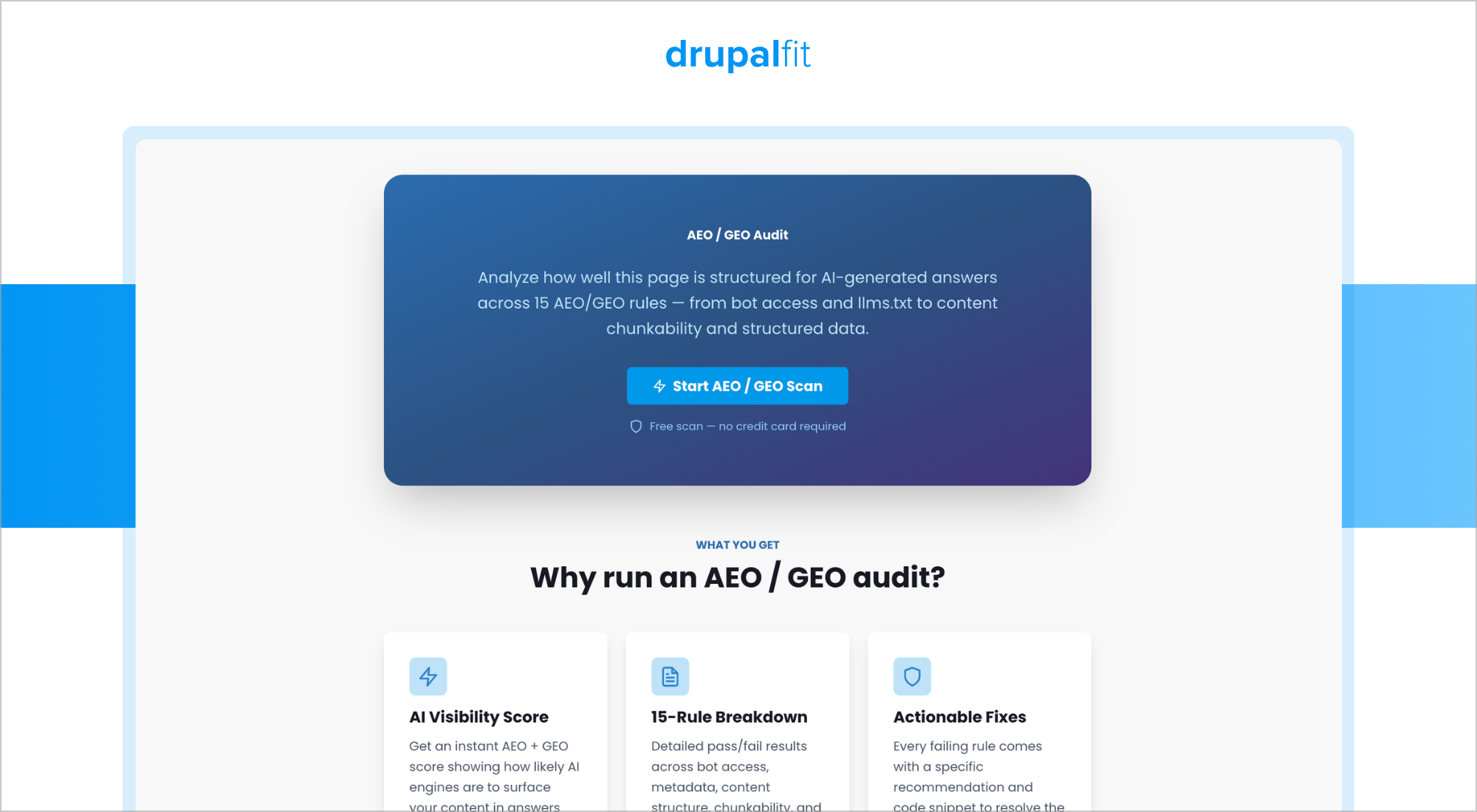
What the Dashboard Shows You
The report opens with three scores you can act on immediately:
- an Overall Score,
- a dedicated AEO Score (how well your content is structured to be extracted as direct answers), and
- a GEO Score (how likely AI models are to cite your content in generated responses).
Each is scored out of 100, so you know exactly how much headroom you're working with.
Alongside the scores, the dashboard shows your total check count, how many are passing, and which ones have issues, broken out by priority, so you're not guessing where to start. There's also a chunkability score that tells you how easily AI models can break your content into usable pieces.
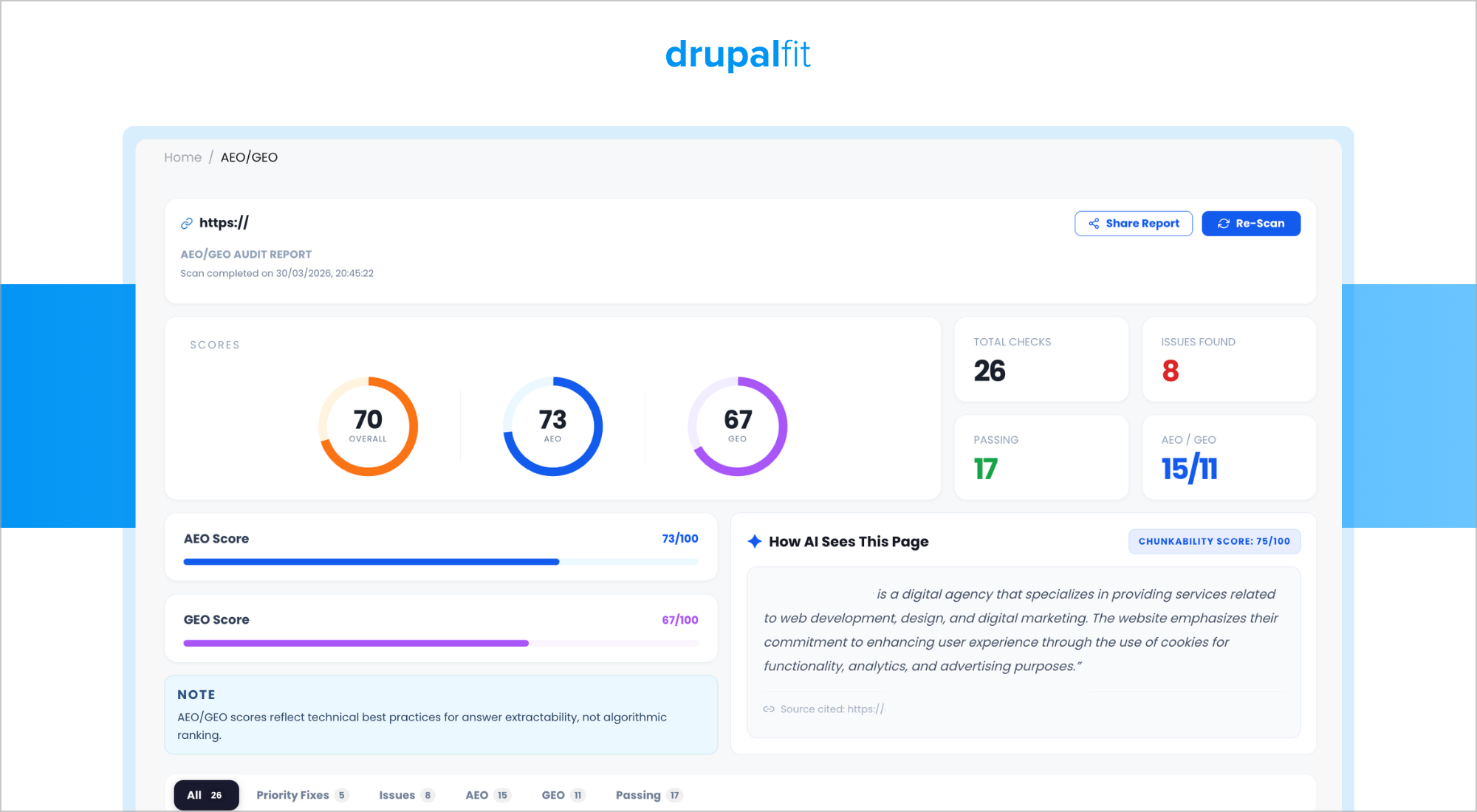
One of the most telling features is "How AI Sees This Page", a live summary generated directly from your content showing exactly what an AI model would extract and cite from your page today. It's often the fastest way to see whether your content is being understood the way you intend, or whether AI is pulling something completely off message.
Every failing check comes with a specific recommendation and, where relevant, a code snippet to resolve it fast, so you're never left wondering what to do with the findings.
What DrupalFit Specifically Checks?
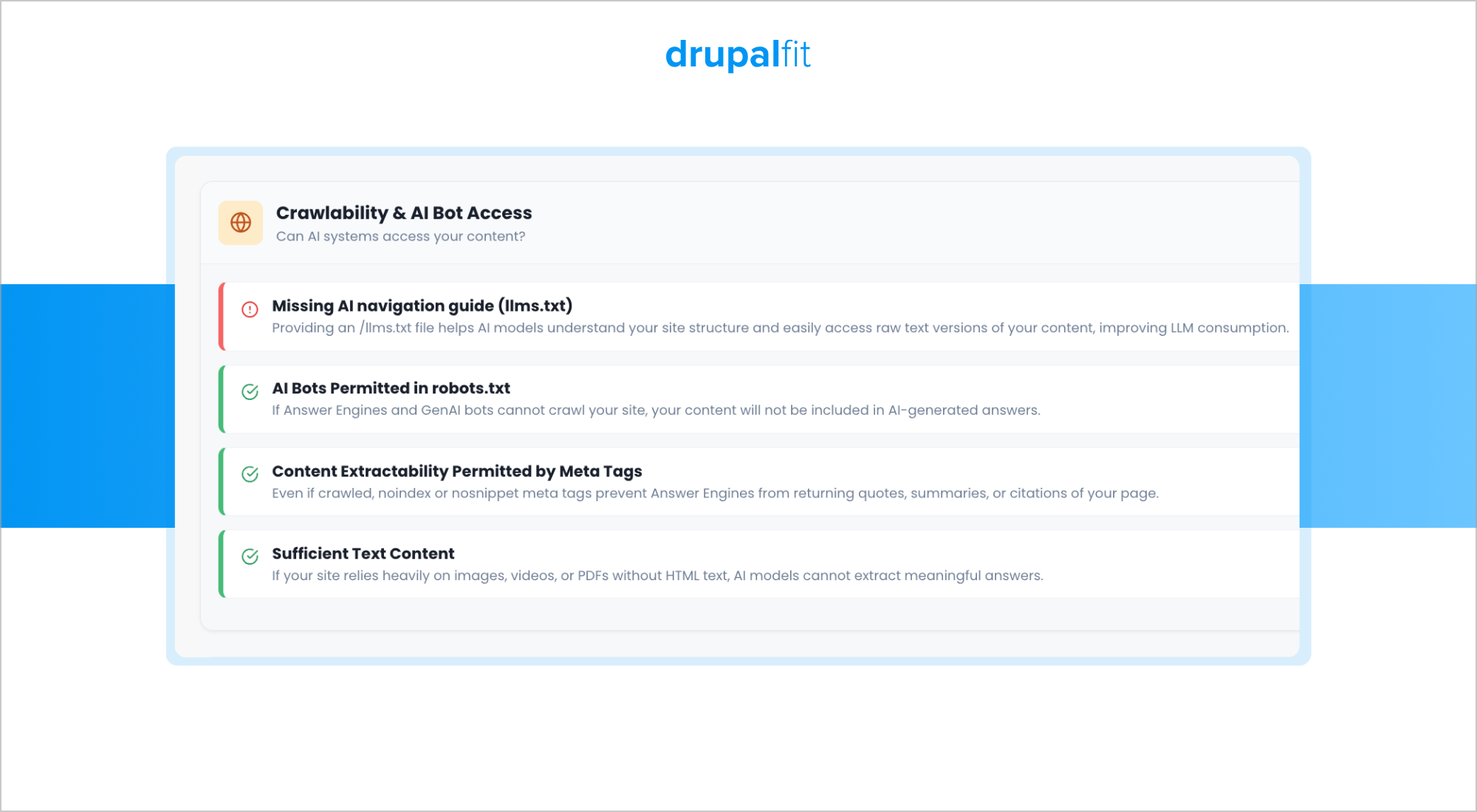
1. On the Crawlability Side: DrupalFit checks whether AI bots are permitted in your robots.txt and whether your content is extractable, meaning no noindex or nosnippet meta tags are silently blocking answer engines from quoting or summarizing your pages.
It also flags whether your site has an llms.txt file, the emerging navigation guide that helps AI models understand your site structure and access raw text content more efficiently; without it, LLMs are essentially reading your site blind.
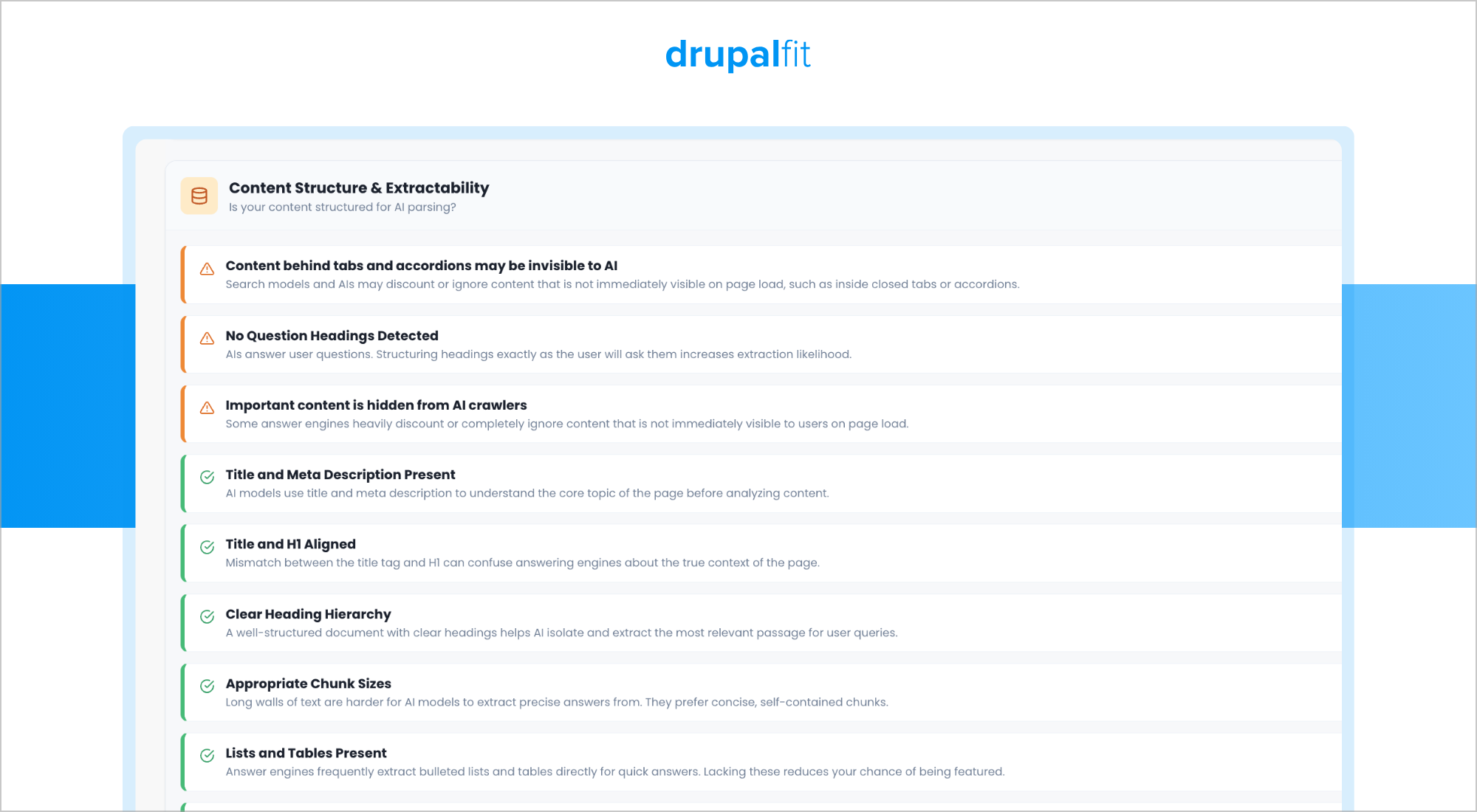
2. For Content Structure: DrupalFit detects whether your headings are written as questions, since AIs answer user questions and structuring headers as queries directly increases extraction likelihood, and whether important content is hidden inside tabs, accordions, or loaded via JavaScript, which answer engines frequently discount or ignore entirely.
It also checks whether your core answer appears early in the page, since placing key information late dramatically reduces the chance of being selected as an AI snippet.
3. On Authority and Trust Signals: DrupalFit audits for missing entity schemas and author identity markup, both of which AI systems use to verify who created the content and whether the source is credible enough to cite.
It also checks for FAQPage and How To schema, which provide direct question-to-answer mappings that AI models consume readily, and flags whether outbound citations to authoritative sources are present, since Perplexity and other answer engines actively correlate well-cited pages with higher information trustworthiness.
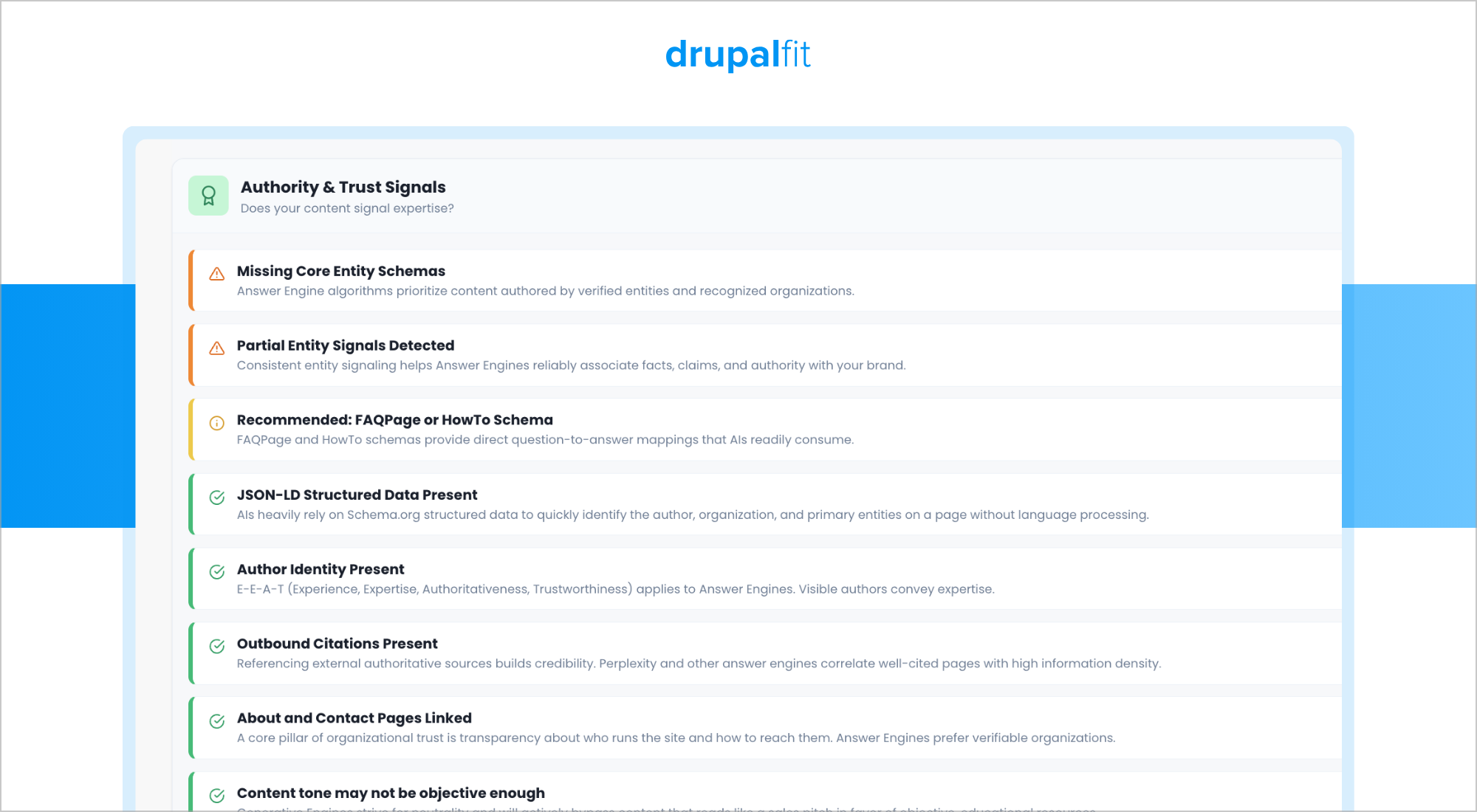
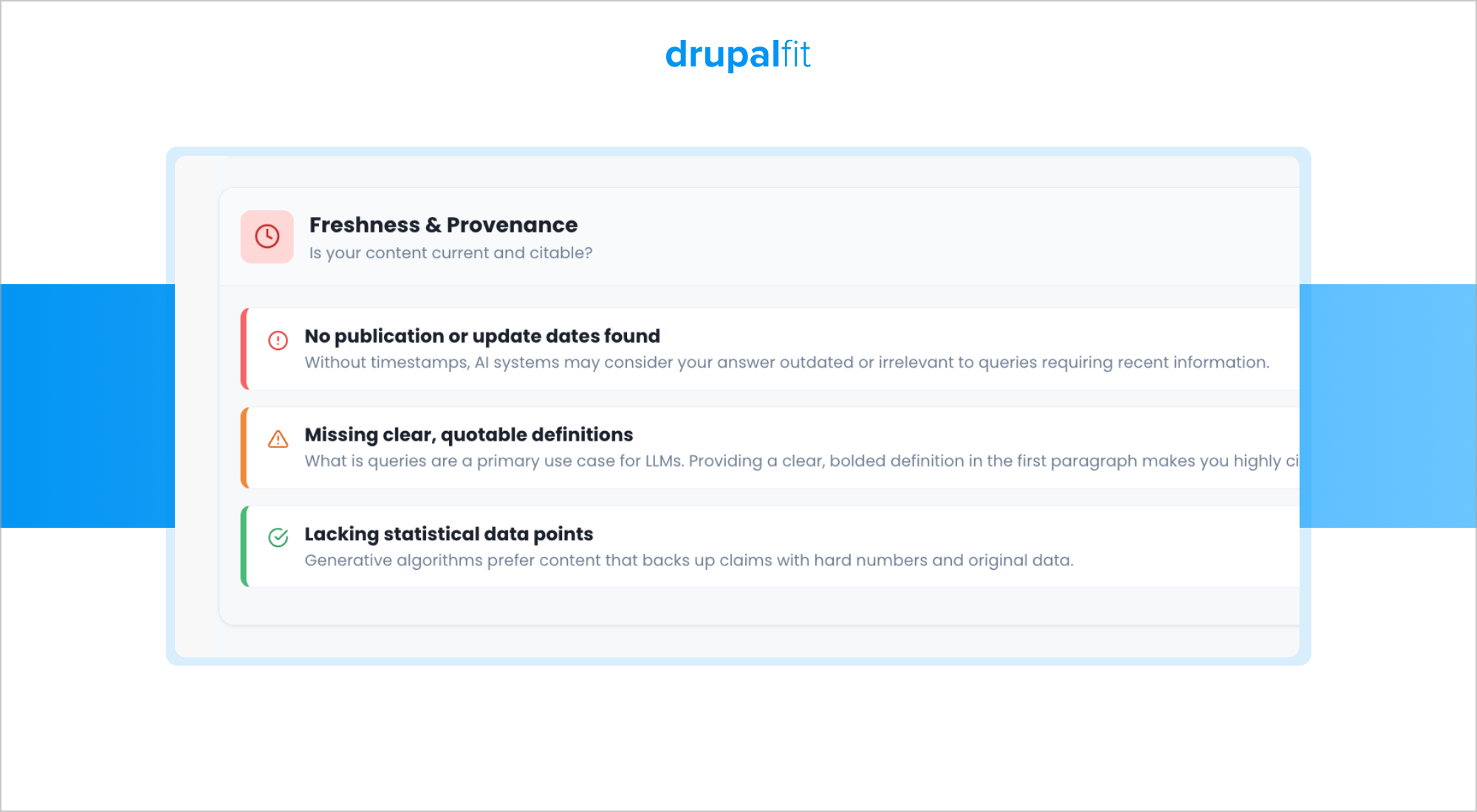
4. Under Freshness and Provenance: DrupalFit identifies one of the most missed issues, missing publication and update dates. Without timestamps, AI systems may treat your content as outdated and deprioritize it entirely for queries where recency matters, even if the content itself is accurate and well-structured.
Be prepared for a different reporting conversation with stakeholders. The "we rank #2 for this keyword" metric is increasingly insufficient as a standalone measure of search visibility. Impressions, citations, and AI mentions all carry real business value, even without a click.
Get a Clearer Picture with DrupalFit...
The brands winning in 2026 are not choosing one over the other; they’re building content that performs across all three layers.
But most websites are still not optimized for how AI systems actually read, extract, and cite content. And without clear visibility into these gaps, you’re likely losing traffic, mentions, and authority without even realizing it.
That’s where DrupalFit changes the equation.
Instead of guessing what’s broken, you get a clear, prioritized audit across GEO and AEO, so you know exactly what’s stopping your content from ranking, being selected, or getting cited.
And see how your site performs in the new search ecosystem.