
AI and the Future of SEO: A Complete Analysis
Nisha Katariya
Published on November 24, 2025
13 min read
Share on:
AI and the future of SEO are increasingly intertwined as search engines deepen their understanding of user intent, context, and language.
Google’s move towards AI-driven ranking systems has altered how websites are discovered and evaluated. Instead of just matching keywords, today’s search algorithms interpret meaning, relevance, and user behavior, shifting SEO from technical tricks to providing real value and clarity.
The rise of AI in search started in 2015 with RankBrain, the first major indication that machine learning was influencing how Google interprets queries. RankBrain enabled Google to grasp the intent behind user searches, even when they were vague.
This was a pivotal moment when AI transitioned from being an experimental feature to a fundamental aspect of the search engine’s decision-making process.
Then, in 2019, Google introduced BERT, a major step forward in understanding context and language. BERT doesn’t just read words; it understands how they relate to one another in a sentence, leading to more accurate and meaningful search results.
Together, RankBrain and BERT signify a major advancement: search engines are no longer merely matching keywords; they are understanding language in a way that resembles human comprehension.
As AI continues to evolve, its influence on SEO will only increase. Grasping this change today is essential for remaining competitive in the future.
And before you adapt, you first need to know where your website currently stands in terms of SEO and across other essential parameters like performance, security, and accessibility.
Now, let's understand...
How AI Is Shaping SEO?
AI is shaping SEO by helping businesses improve content, forecast search trends, and customize user experiences.
For instance, AI tools like Google’s Search Generative Experience (SGE) provide quick, relevant answers, minimizing the need for users to navigate through several links.
A major effect of AI on SEO is its capacity to tailor search results. AI and the Future of SEO can grasp user intent more effectively than before, offering more relevant and personalized search outcomes. This change is vital for businesses looking to fulfill their customers’ unique needs and preferences.
AI-driven SEO tools lead this change. They provide features like detailed keyword research, content enhancement, and predictive analytics. By leveraging AI for SEO, businesses can uncover impactful keywords, predict emerging search patterns, and optimize content for higher rankings, aligning directly with how AI and the Future of SEO are evolving. This not only boosts visibility but also keeps content relevant and appealing to target audiences.
Adopting AI-based SEO strategies helps businesses remain competitive in a constantly changing digital environment. The ability to swiftly adjust to shifts in search engine algorithms and user behavior ensures that businesses can sustain their online presence and draw a consistent flow of organic traffic.
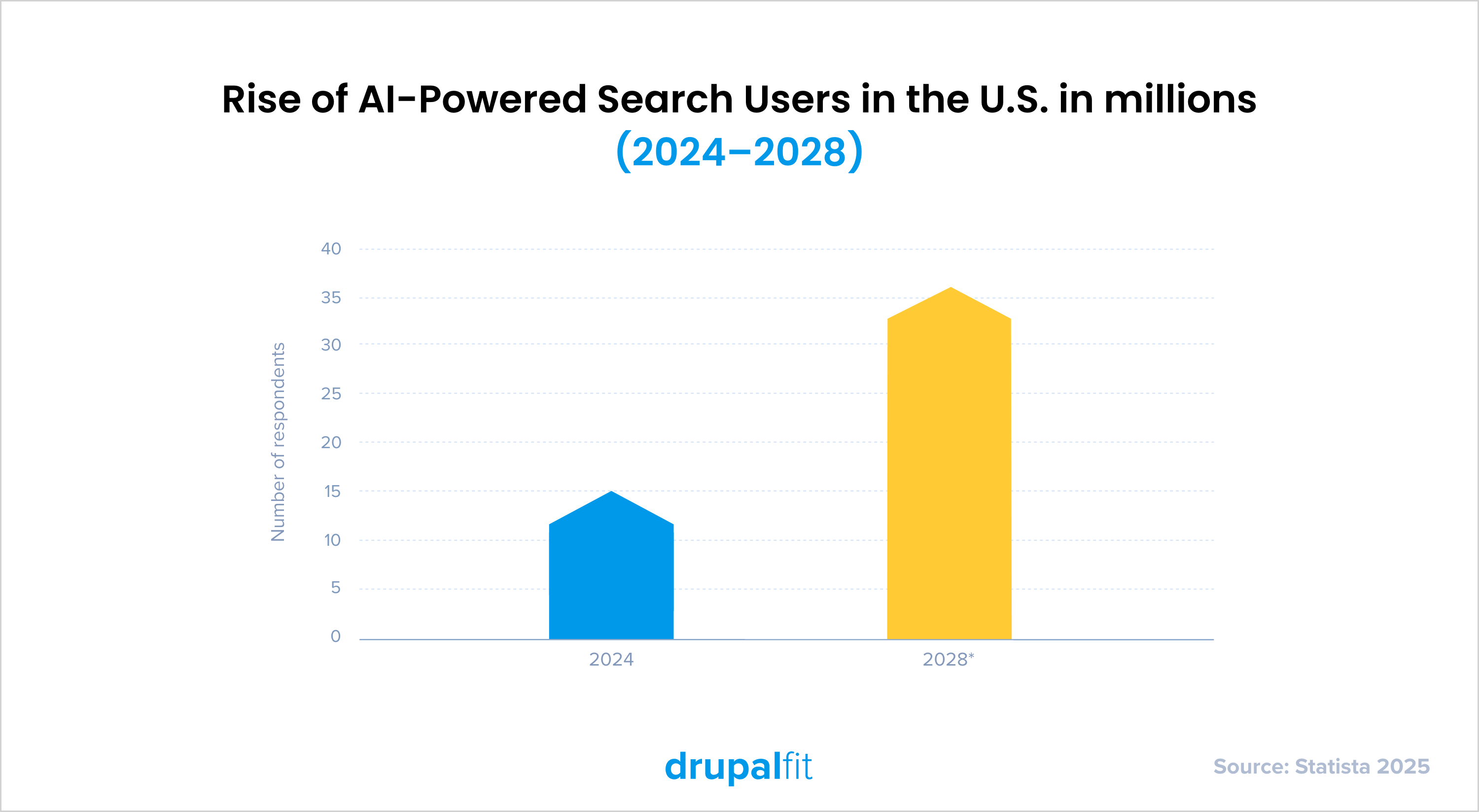
In 2024, around 15 million adults in the United States claimed they used generative AI as their primary tool for online search. By 2028, this number is projected to rise to over 36 million users.
This shift signals a massive change in how people prefer to find information.
As more users rely on AI-powered search tools for quick, conversational, and context-aware answers, the global online search market is experiencing a significant transformation.
AI SEO: Methods to Utilize AI for Improving Your Website
Artificial intelligence is changing SEO by providing quicker insights, better automation, and more precise optimizations.
Rather than taking over human creativity, AI enhances it, assisting teams in making data-driven choices, refining strategies, and boosting website performance.
To maximize its benefits, companies need to actively incorporate AI tools into their SEO processes.
Below are the most effective methods to utilize AI for enhancing your website:
- Industry Research: AI SEO tools can effectively detect changes in consumer behavior and market trends. Using AI tools for industry research gives you a strategic advantage, ensuring your SEO strategies align with the latest market dynamics.
- Competitor Research: Discover what your competitors are doing, what strategies succeed for them, and what fails. Don’t just match the competition; surpass them by utilizing insights from AI-driven competitor research.
- Keyword Research: Find relevant, high-performing keywords, anticipate keyword trends, and effectively target the right keywords. AI SEO tools equip you with optimized keywords that can increase traffic and conversions.
- Content Clusters: AI SEO optimization tools can outline the key industry topics your website should address and create content clusters to organize related content. Make sure your website is thorough, well-structured, and authoritative to enhance your SERP rankings.
- Content Audit: Spot content gaps, point out missing or outdated information, and discover optimization opportunities. Leverage insights from AI tools to refine your content strategy and gain a competitive advantage.
- Content Outlines: AI SEO tools can produce detailed content outlines and recommend the best structure for your content based on insights from keyword and competitor research. AI can assist you in crafting high-quality, SEO-optimized content that effectively meets audience needs.
- Content Creation: AI SEO tools feature advanced natural language processing capabilities, enabling the rapid and efficient production of content tailored to search intent and specific keywords. It’s crucial to remember that AI-generated content needs oversight.
- Content Relevance: AI significantly contributes to content optimization. AI SEO tools can forecast content performance and recommend enhancements.
- Internal Linking: AI tools can evaluate your website's structure and identify internal linking chances to distribute link equity throughout the site, improving the overall user experience.
- Image Alt Text: AI can automatically create SEO-friendly and descriptive alt text for your images, ensuring they also play a role in your overall SEO strategy.
- Meta Tags: Create engaging, keyword-rich meta tags. AI can assess page content to produce relevant meta tags that boost click-through rates. AI-optimized meta tags that offer a clear and appealing summary motivate users to visit your site.
- Schema Markup: Utilize AI to create schema markup that increases your website's visibility. AI automatically produces the required code and supplies detailed information in search engine results, enhancing user engagement and SEO performance.
- Data Analysis: Use AI for data analysis to gain a thorough understanding of your website's performance, keywords, and user behavior.
Also Check Out
- Technical SEO Excellence: Boost Visibility with Smart Audits Using DrupalFit
- Digital Accessibility Compliance: A Practical Guide
- Website Audit: Perform Like a Pro and Elevate Your Digital Experience
- Full-Spectrum Site Analysis: Where SEO, Performance, Security & Accessibility Converge
Are AI search engines the future of searching?
Yes, at least part of it.
Search engines like Google and Bing are not going away anytime soon. Google has a strong grip on the market, making it hard to outdo any other search engine.
However, this doesn’t mean that AI search engines won’t be part of the future. In fact, they are likely to have a significant role in the future of search.
The primary reason AI search engines represent the future of search is that they provide something unique that traditional search engines lack: conversation.
When using a traditional search engine, there is little interaction between you and the engine. You enter your query in the search bar and then look at the search results for information.
Although Google has AI Overviews to make the search experience easier, it doesn’t create a conversational aspect as AI search engines do.
Other AI search engines, such as ChatGPT and Perplexity, foster a conversational dynamic where you can search for a query, receive information, and ask follow-up questions. They utilize the context of previously shared information to enhance the conversation.
This kind of search experience is attractive to many users. Not only do AI engines summarize information for the user, but they can also ask follow-up questions and receive answers with minimal extra effort.
Therefore, while AI search may not be the only method of searching in the future, it will still have a significant presence in the search experience and must be considered.
And if the search experience is evolving, your website must evolve with it. Check if your site is optimized for modern search expectations: SEO, speed, security, accessibility, and content clarity.
What do you think...
AI and the Future of SEO Will Dominate the SERP
As previously mentioned, Google’s AI Overviews place generative AI responses at the top of the SERP, summarizing key information, pulling in sources, and reducing the need for users to click through multiple sites. With these summaries becoming more common, the way users discover information is shifting, and publishers, SEOs, and content creators must adapt their strategies accordingly.
But the main worry is whether Google’s AI Summaries will reduce click-through rates. If CTR does drop, to what extent?
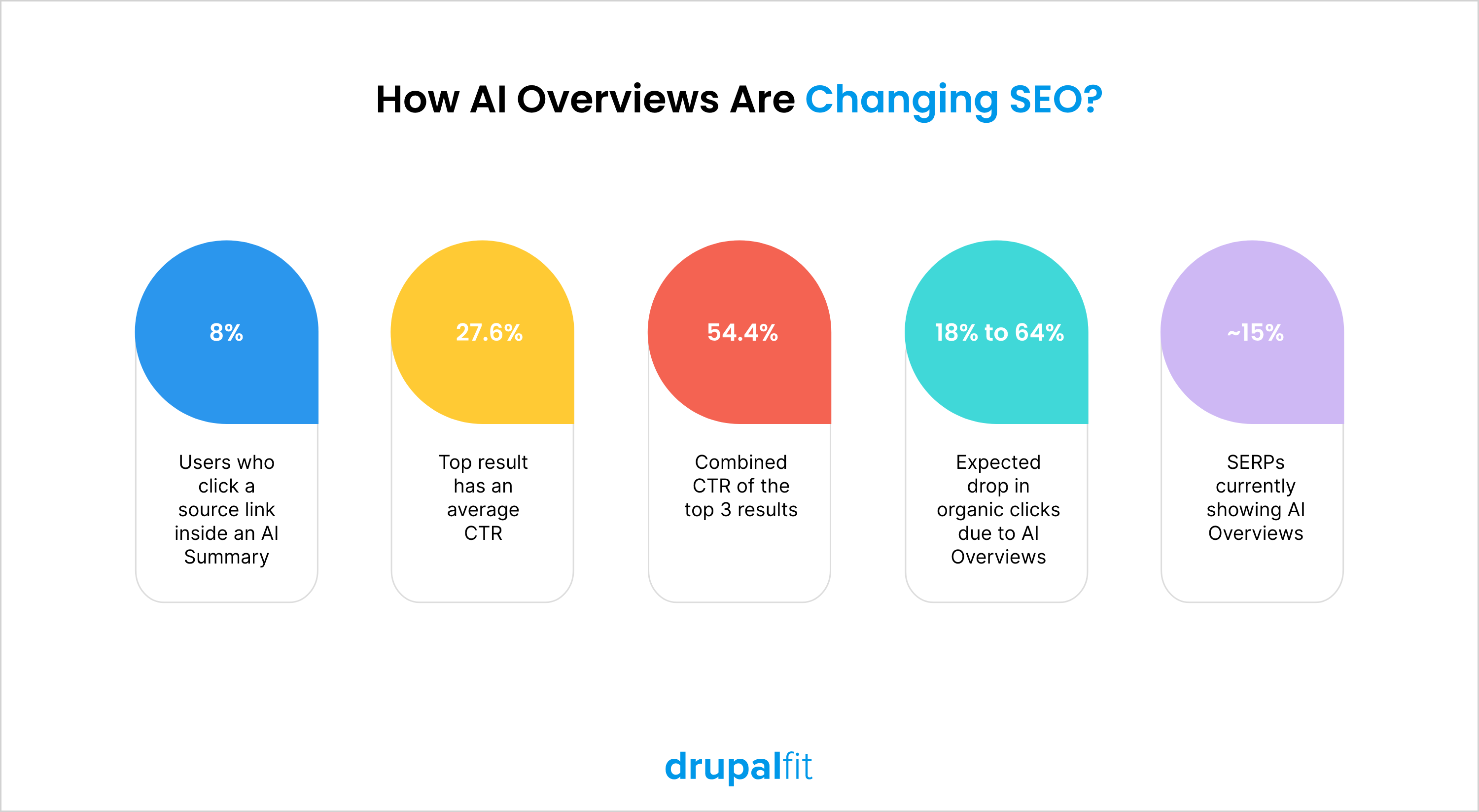
Research from Exploding Topics indicates that merely 8% of individuals will consistently click through from a link in an AI Summary to the source material.
Backlinko’s analysis suggests that the top result has an average CTR of 27.6%. Furthermore, the top 3 results on the SERP account for 54.4% of all clicks.
With the emergence of AI Overviews, it is anticipated that these rates may decline. Although they are still relatively new to the search engine results page, initial indications show they could cause an 18-64% reduction in organic clicks for certain queries.
Currently, around 15% of SERPs are thought to include an AI overview. However, this figure is projected to increase in the coming years.
To adapt, businesses and publishers should focus on positioning their content for inclusion in AI-generated summaries instead of concentrating solely on ranking traditional blue links.
For instance, when mobile search became popular, there were widespread fears that smaller screens would lead to fewer clicks for publishers.
Contrary to those fears, the opposite occurred. Although clicks may have dropped at first, more people began searching overall, resulting in an increase in total clicks.
A similar situation arose when Google launched featured snippets. Initially, publishers worried they would lose clicks because searchers could find answers directly on the SERP.
Yet again, the impact was minimal, and publishers continued to prosper. It simply became another aspect to optimize for when developing new content: we are entering the age of generative engine optimization (GEO).
Thus, while AI Overviews could greatly alter the search experience, AI is likely to be integrated into SEO strategies rather than being a factor that diminishes your website’s traffic and SEO effectiveness.
Latest Trends in AI and the Future of SEO
As AI and the future of SEO come together, new trends are appearing that highlight how artificial intelligence is changing optimization strategies with more sophistication and accuracy. These developments are not just altering SEO practices but also affecting wider digital marketing choices and creating better investment opportunities. Discussed below are some important trends that are changing AI and the Future of SEO:
AI-Generated SEO Content Is Now Common
AI writing tools enable the rapid creation of large amounts of content, helping websites to publish more articles and target additional keywords. More people are utilizing AI tools than ever before.
Research from CoSchedule indicates that 85% of marketers are using AI tools for content creation.
However, content produced entirely by AI often lacks originality and depth. Relying on AI to write about topics already covered by competitors can lead to the production of very similar content.
This poses a challenge because Google evaluates content quality based on factors such as originality. According to Google, it’s the quality that counts, not the method of content creation:
“Our focus on the quality of content, rather than how content is produced, is a useful guide that has helped us deliver reliable, high-quality results to users for years.”
Without adequate editing and a dedicated effort to incorporate unique insights, AI-generated content may not meet expectations. This can impact your search rankings and your chances of being featured in experiences like AI Overviews and AI Mode.
Alternatives to Google Are Gaining Popularity
Users are broadening their search beyond Google for research, turning to other search engines and AI tools.
Bing's share of the search market has risen in recent years. Additionally, over half of U.S. consumers now initiate product searches on Amazon rather than on conventional search engines.
Aligning with Search Intent Is Important
Search engines and AI systems focus on content that aligns closely with user searches (their search intent), text relevance. It refers to how well your content meets what users are looking for when they search.
This idea is equally vital for AI tools. In fact, matching intent may be even more critical due to the very specific questions users often pose to tools like ChatGPT.
This indicates that your pages must deliver the most useful information for particular queries.
Credibility Is Even More Important
Google's goal is to rank content that fits its Experience, Expertise, Authoritativeness, and Trustworthiness (E-E-A-T) framework. This same framework can also assist you in creating content that is more likely to be referenced in AI responses.
While E-E-A-T itself is not a direct ranking factor, real users apply this framework to evaluate the quality of search results. Their input can influence future updates to Google's algorithms.
Additionally, research indicates that using statistics, including quotes, and referencing credible sources can increase your chances of appearing in AI responses.
AI Tools Are Changing SEO Processes
SEO experts are quickly using AI tools to make their work easier, not only for creating content.
AI tools such as ChatGPT are great at handling big data, spotting trends, and offering fast insights. They can also help with on-page optimization and technical SEO evaluations, making slow tasks faster.
However, AI and the future of SEO demonstrate that AI performs best when supported by human judgment and a well-defined strategy.
Also Check Out
- DrupalFit: Your One-Stop Solution for Security, Accessibility & Performance
- DrupalCon Vienna 2025: What’s Coming & What We’re Bringing
- DrupalFit Challenge at DrupalCon Vienna: Celebrating the Fittest Drupal Websites
Key Takeaways
- AI is transforming SEO rapidly, shifting the focus from keywords to intent, relevance, and user experience.
- AI and the Future of SEO show a clear trend: more users are relying on conversational AI tools for search.
- AI and the Future of SEO suggest that while AI Overviews may lower CTR, they also open new opportunities through Generative Engine Optimization (GEO).
- AI elevates SEO performance, but human insight is important to maintain quality, precision, and trustworthiness.
- Search engines and AI systems prioritize text relevance, which indicates how effectively your content satisfies what users seek during their searches.