
EAA vs ADA Compliance: What Drupal Site Owners Need to Know
Palak Agrawal
Published on August 13, 2026
8 min read
Share on:
If you own or manage a website, the technical accessibility work required under the Americans with Disabilities Act and the European Accessibility Act is largely the same. Both frameworks are built around making digital experiences accessible and point organizations toward WCAG 2.1 Level AA.
The differences lie elsewhere.
The ADA is a U.S. law primarily enforced through complaints, lawsuits, and government investigations. The EAA is a European regulation enforced by national authorities and comes with additional documentation and EAA compliance requirements.
Depending on where your users are located, your organization may need to comply with one, the other, or both. In this article, we'll look at what the ADA and EAA cover, where their requirements overlap, and the key differences website owners should understand.
What Is the ADA?
The Americans with Disabilities Act or ADA is a U.S. civil rights law that prohibits discrimination against people with disabilities.
Although the law was enacted in 1990 before websites became a central part of business operations, courts have increasingly interpreted it to apply to digital experiences. As a result, organizations are expected to ensure that people with disabilities can access and use their websites, applications, and digital services. Following American Disability Act guidelines starts with understanding which title applies to your organization.
For website owners, the most relevant sections are:
Title II, which applies to state and local government organizations.
Title III, which applies to businesses that serve the public.
In 2024, the U.S. Department of Justice formally adopted WCAG 2.1 Level AA as the accessibility standard for state and local government websites and applications, tightening ADA compliance requirements for the public sector. For private businesses, courts frequently use the same standard when evaluating accessibility claims.
What Is the EAA?
The European Accessibility Act or EAA is a European Union law that sets accessibility requirements for digital products and services sold or provided within the EU. The law became enforceable on June 28, 2025.
Understanding European Accessibility Act requirements starts with knowing which industries and services the law covers. The EAA applies to a range of industries, including e-commerce, banking, telecommunications, transport services, and digital publishing. Unlike the ADA, which does not explicitly mention websites, the EAA directly covers digital services.
The law uses EN 301 549 as its technical standard, which forms the technical backbone of EAA compliance requirements. This standard is based on WCAG 2.1 Level AA and includes additional requirements for certain products and technologies.
If your website serves customers in the European Union, the EAA may apply regardless of where your organization is headquartered.
Are ADA and EAA Similar?
At this point, you might think the ADA and EAA are completely different. That's only partly true. While they differ in scope, enforcement, and compliance requirements, there is significant overlap when it comes to the technical work involved.
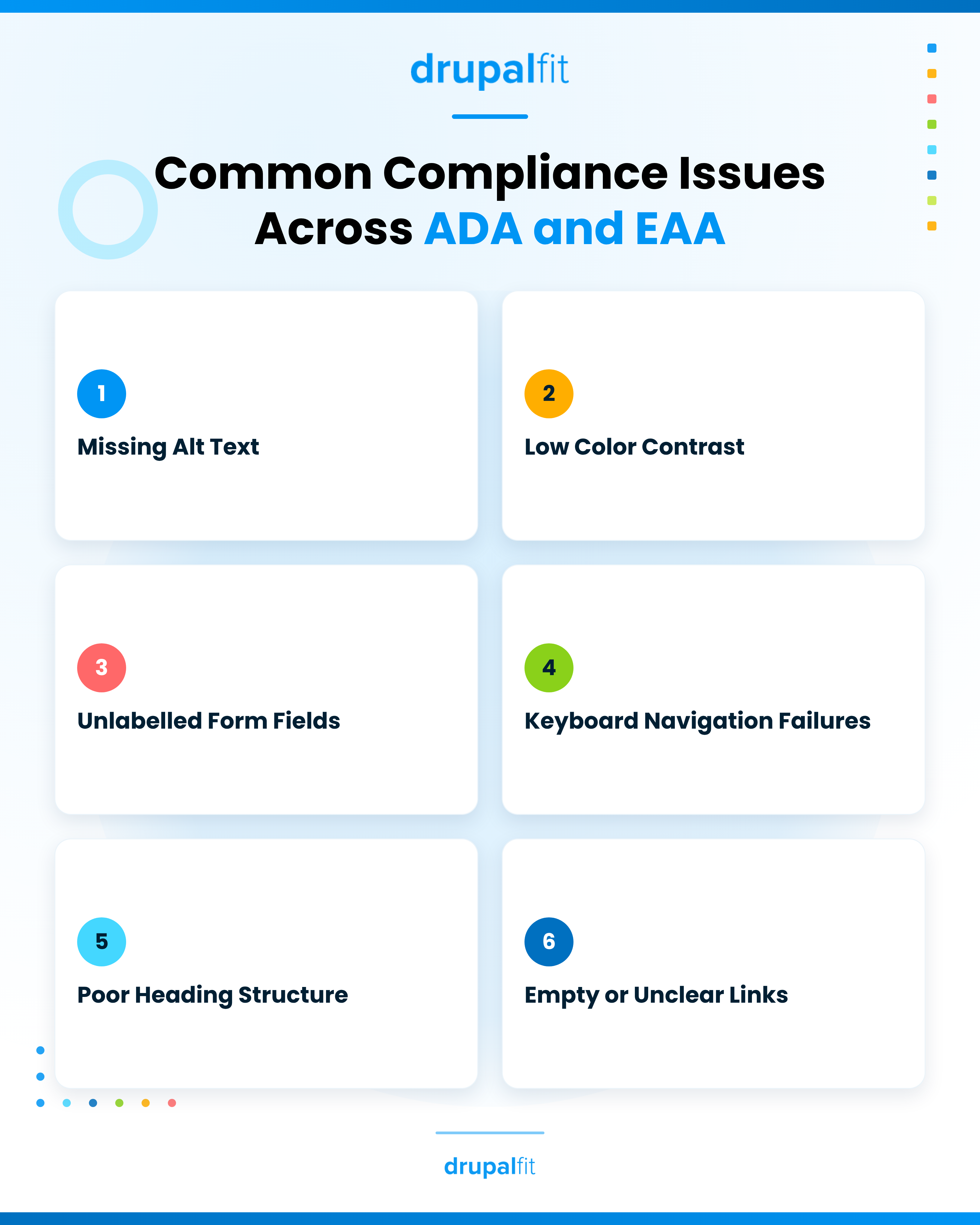
Both frameworks are closely aligned with WCAG 2.1 Level AA, which means many of the issues organizations need to fix are the same. Missing form labels, poor color contrast, inaccessible navigation, and missing alt text can create compliance risks under both the ADA and the EAA. In other words, ADA compliance and EAA compliance frequently require fixing the same underlying issues.
What is the Difference Between ADA and EAA Compliance?
Both laws converge on the same technical target, WCAG 2.1 AA. What makes them distinct is who they cover, how each one gets enforced, and what an organization has to document to prove it's compliant.
Category | ADA | EAA |
Covers | Title II: government. Title III: private business | Private businesses with named products/services |
Geography | US and its territories | All EU member states |
Standard | WCAG 2.1 AA (mandatory under Title II) | EN 301 549 (incorporates WCAG 2.1 AA) |
Exemptions | Undue burden defence | Micro-enterprises under 10 staff or €2M turnover |
Penalties | Up to $75,000 (first violation), up to $150,000 (repeat), plus lawsuits and settlements | €100,000 typical administrative cap, up to €1.26M statutory maximum (Hungary, Spain, Netherlands) |
Types of organizations covered
ADA: Title II binds state and local government. Title III binds private businesses open to the public.
EAA: Covers private businesses providing the specific products and services the Act names. A separate EU rule, the Web Accessibility Directive, handles public sector sites instead.
Geographic scope
ADA: The ADA applies throughout the United States and its territories. International companies that serve U.S. customers can also face ADA-related claims.
EAA: It applies across all EU member states. Organizations outside Europe can still be subject to the law if they provide covered services to EU customers.
Technical standards
ADA: For government organizations, WCAG 2.1 Level AA is now a formal requirement. For private businesses, courts frequently use WCAG as the benchmark when evaluating accessibility claims.
EAA: The EAA references EN 301 549, which incorporates WCAG 2.1 Level AA and adds additional requirements where applicable.
Exemptions
ADA: Organizations may argue that a requirement creates an undue burden, but the outcome depends on the specific circumstances.
EAA: Certain obligations may be reduced for micro-enterprises with fewer than 10 employees or annual turnover below €2 million, although accessibility requirements can still apply to the products and services they provide.
Penalties for non-compliance
ADA: Businesses can face fines up to $75,000 for first violations and $150,000 for repeat offences, along with lawsuits and settlement costs.
EAA: EAA penalties are set by each EU country, with administrative fines typically ranging from a few thousand euros to around €100,000 and statutory maximums reaching up to €1.26 million (e.g., Hungary, Spain, Netherlands).
What Business Owners Need to Do About ADA and EAA Compliance
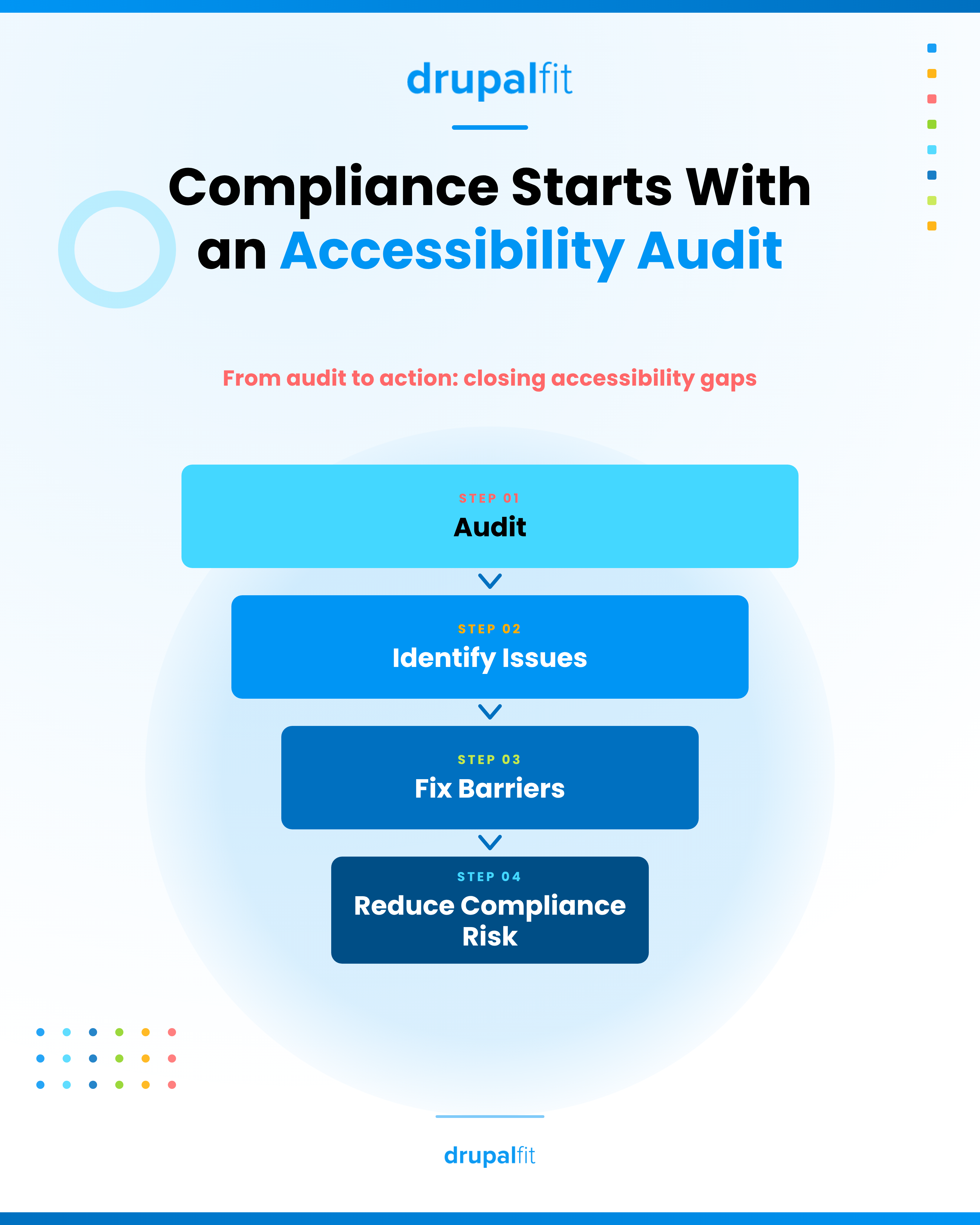
To make sure that your website complies with the ADA, the EAA, or both, you should follow these steps:
Step 1 - Start by understanding your current accessibility posture
Audit your website against WCAG 2.1 Level AA requirements and identify areas that need attention.
Step 2 - Prioritize remediation
Focus first on issues that create barriers for users, such as inaccessible forms, navigation problems, missing labels, and keyboard accessibility failures.
Step 3 - Create repeatable processes
Accessibility should be part of content publishing, design reviews, development workflows, and quality assurance processes.
Step 4 - Maintain documentation
Keep records of audits, remediation activities, testing efforts, and accessibility initiatives. This documentation can be valuable during procurement reviews, audits, or regulatory inquiries.
Step 5 - Monitor continuously
Accessibility is not a one-time project. New content, features, and integrations can introduce issues over time.
Ready to See if Your Site Meets ADA and EAA Accessibility Requirements?
Whether you're working toward ADA requirements, EAA requirements, or both, the starting point is the same: understand where your site stands today.
For Drupal websites, accessibility gaps often stem from:
- Theme choices that introduce barriers
- Contributed modules that affect usability
- Content added after launch, such as missing alt text, poor heading structure, or unclear link labels
An accessibility audit can uncover these issues before they become compliance or legal concerns. DrupalFit's Accessibility audit helps teams continuously monitor their websites, identify WCAG violations, and receive actionable remediation guidance so problems can be addressed before an audit, procurement review, or legal complaint.
FAQs
1. Do I need separate compliance strategies for ADA and EAA on the same site?
Usually not. Both frameworks are closely aligned with WCAG 2.1 Level AA. The technical work largely overlaps, although documentation and regulatory obligations may differ.
2. What's the maximum ADA fine for a first violation?
Up to $75,000 for a first violation and up to $150,000 for repeat offences, separate from any lawsuit or settlement costs a business might also face.
3. How much can EAA non-compliance actually cost?
It depends entirely on the country, since each EU member state sets its own penalty structure. Administrative fines typically top out around €100,000, though statutory maximums reach as high as €1.26 million in countries such as Hungary, Spain, and the Netherlands.
4. Does meeting WCAG 2.1 Level AA satisfy both laws?
Meeting WCAG 2.1 Level AA addresses the primary technical accessibility requirements under both frameworks. However, organizations may still have additional obligations related to documentation, reporting, and compliance processes.